
A blank wall rarely needs more stuff. It needs the right stuff at the right size, hung at the right height. Most wall decor ideas fail on measurements, not taste: the art is too small, the frames float too high, or the grouping spreads wider than the sofa beneath it. Fix three numbers first and almost any idea in this guide lands well. Galleries hang their art with the center of each piece 57 inches from the floor. Designers size art at two-thirds the width of the furniture below it. Grouped frames sit 2 to 3 inches apart, close enough to read as one unit. The sections below pair each idea family with the exact sizes, spacing, and hardware that make it work.
Measure First: Three Numbers That Decide the Whole Wall
Three numbers decide whether a decorated wall looks planned or random: a center height of 57 inches for art, a width near two-thirds of the furniture below the art, and 2 to 3 inches of space between grouped frames. Tape measures settle arguments that taste cannot. A 36 by 48 inch canvas above an 84 inch sofa follows the width rule almost exactly, since two-thirds of 84 inches is 56 inches and the canvas plus its frame lands close to that mark. Your eye level standing in a room averages 57 to 60 inches, so art centered at 57 inches meets your gaze without a tilt of the head. Over furniture, the rule bends slightly: the bottom edge of a frame should sit 6 to 8 inches above a sofa back or console top, close enough to connect the two pieces visually. Write the three numbers on painter’s tape stuck to the wall before you drill anything, if the layout is new to you.
The 57-Inch Rule and Where It Bends
Galleries and museums hang work at 57 inches on center, meaning the middle of the piece, not the top, sits at that height. Measure the frame height, divide by two, and add the result to 57 to find the top edge; then subtract the drop from the top edge to the hanging wire or D-ring to find the hook point. A 30 inch tall frame with a 2 inch wire drop puts its top edge at 72 inches and its hook at 70 inches, and you can verify both marks with tape before the nail goes in. Dining rooms bend the rule downward: seated eyes sit lower, so art there often centers at 54 to 56 inches and reads correctly from the table.
Width, Spacing, and Breathing Room
Single pieces look lost below half the furniture width, and they crowd the wall past about 80 percent of it. Two-thirds is the safe middle. Groupings follow the same math as one imaginary frame: measure the full outer width and height of the arrangement and treat that block as the artwork. Inside the block, 2 to 3 inches between frames keeps pieces related. Gaps of 5 inches or more break the group into lonely singles, and guests notice the drift. Keep at least 4 to 6 inches between the outer frame edges and any corner, door trim, or window casing, if the wall section is narrow.

Build a Gallery Wall That Reads as One Piece
A gallery wall works when the entire group reads as one large rectangle, built by placing the biggest piece first and filling smaller frames around it with even 2 to 3 inch gaps. Start on the floor, not the ladder. Lay the full arrangement on the ground in front of the wall, photograph it, then trace each frame onto kraft paper and transfer the outlines to the wall at full size. Plenty of wall decor ideas look strong in a store display and fall apart at home for one reason: nobody rehearsed the layout before drilling. Living with tape outlines for a day costs nothing, and it exposes a weak layout before a single hole exists. A grid layout, with identical frames in even rows, suits modern rooms and photo collections. Salon style, mixed sizes packed edge to edge in the spirit of old European salons, suits collected art and vintage finds. Both styles obey the same anchor rule: the group’s center lands at 57 inches. One homeowner formula that rarely fails is 6 to 9 frames for a standard sofa wall, mixing one 24 by 36 inch anchor with 11 by 14 and 8 by 10 inch fillers.
Keep the Group Unified
Mixed frames look intentional when one element repeats. Match the frame color, the mat color, or the photo treatment, black and white being the easiest unifier. Black frames with white mats can hold a wedding photo, a map, and a child’s drawing without visual friction. Bulk packs of one frame style save real money, and the wall looks collected rather than accumulated.
Go Big With One Oversized Piece
One oversized piece, at least 40 inches wide, fills a wall faster, calmer, and often cheaper than a cluster of small frames. Scale is the point. A 60 by 40 inch canvas over a 90 inch sectional hits the two-thirds rule in a single purchase, and it needs exactly two hooks. Wide horizontal pieces suit walls above sofas and beds, while a tall 36 by 60 inch piece suits a narrow entry wall or the space beside a fireplace. Big art also forgives plain furniture, since the eye goes to the wall first. Renters get the same effect without holes by leaning a large framed piece on a mantel or console. Oversized canvases start around $80 to $150 at home stores in 2026, and a printed shower curtain stretched over a lumber frame remains the cheapest route to a 5 foot piece, if your budget is tight and your staple gun is ready.
Use Mirrors to Borrow Light and Space
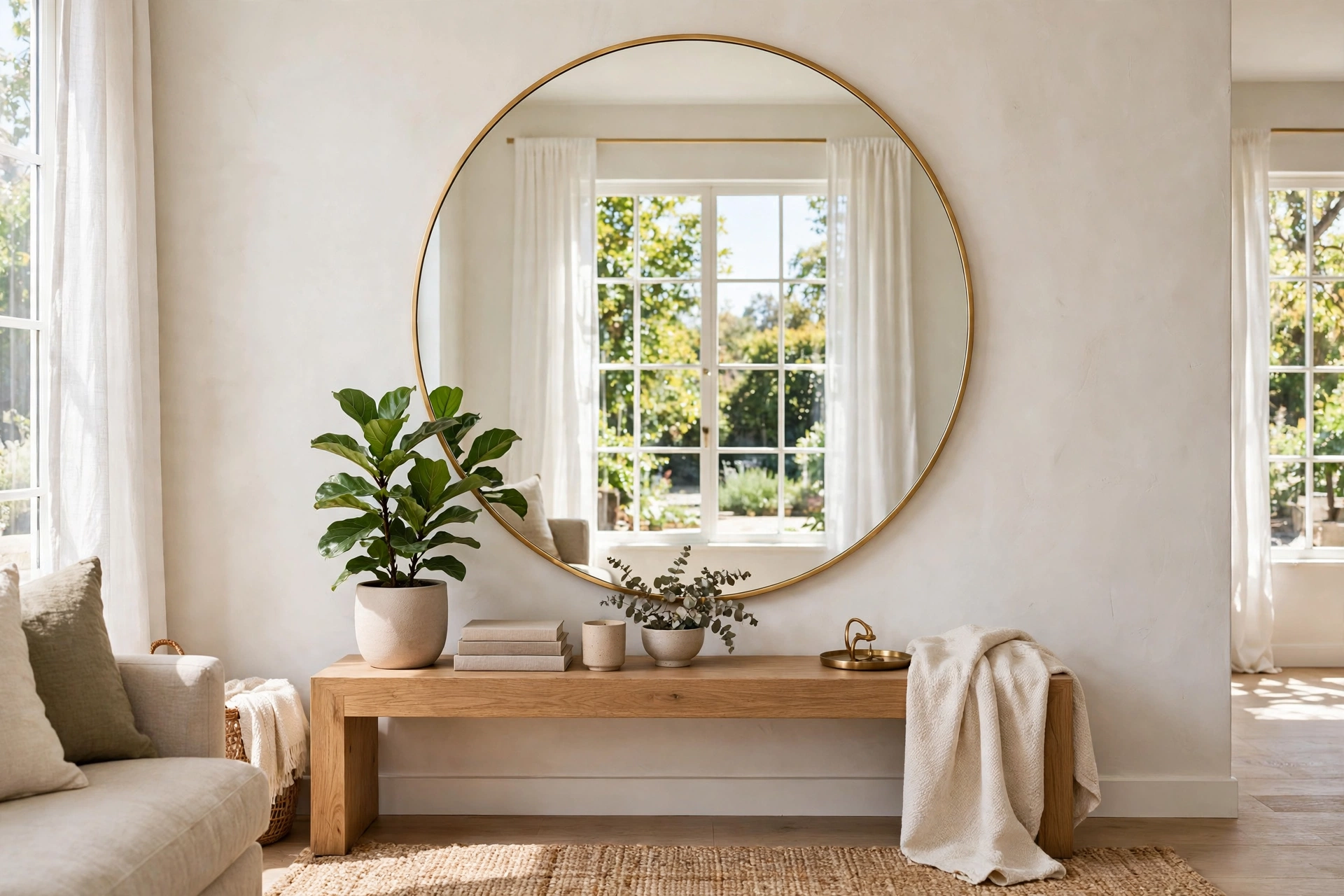
A mirror earns its wall space when it faces a window or another light source, because what a mirror reflects matters more than how big it is. Hang a 36 to 48 inch round mirror opposite a window and it returns daylight deep into the room, which is why small and north-facing rooms benefit most. Facing a cluttered bookshelf or a blank wall wastes the glass. Above a mantel, leave 4 to 6 inches between the mantel shelf and the mirror’s bottom edge, and keep the mirror narrower than the mantel itself. Groups of small mirrors, three to five in mixed shapes, work like a gallery wall with light built in. One placement to skip: directly across from a bright television or a west-facing window at sunset, where glare bounces straight into seated eyes. A light-emitting diode (LED) picture light or two sconces flanking the glass adds evening function, if the wall already has power nearby.
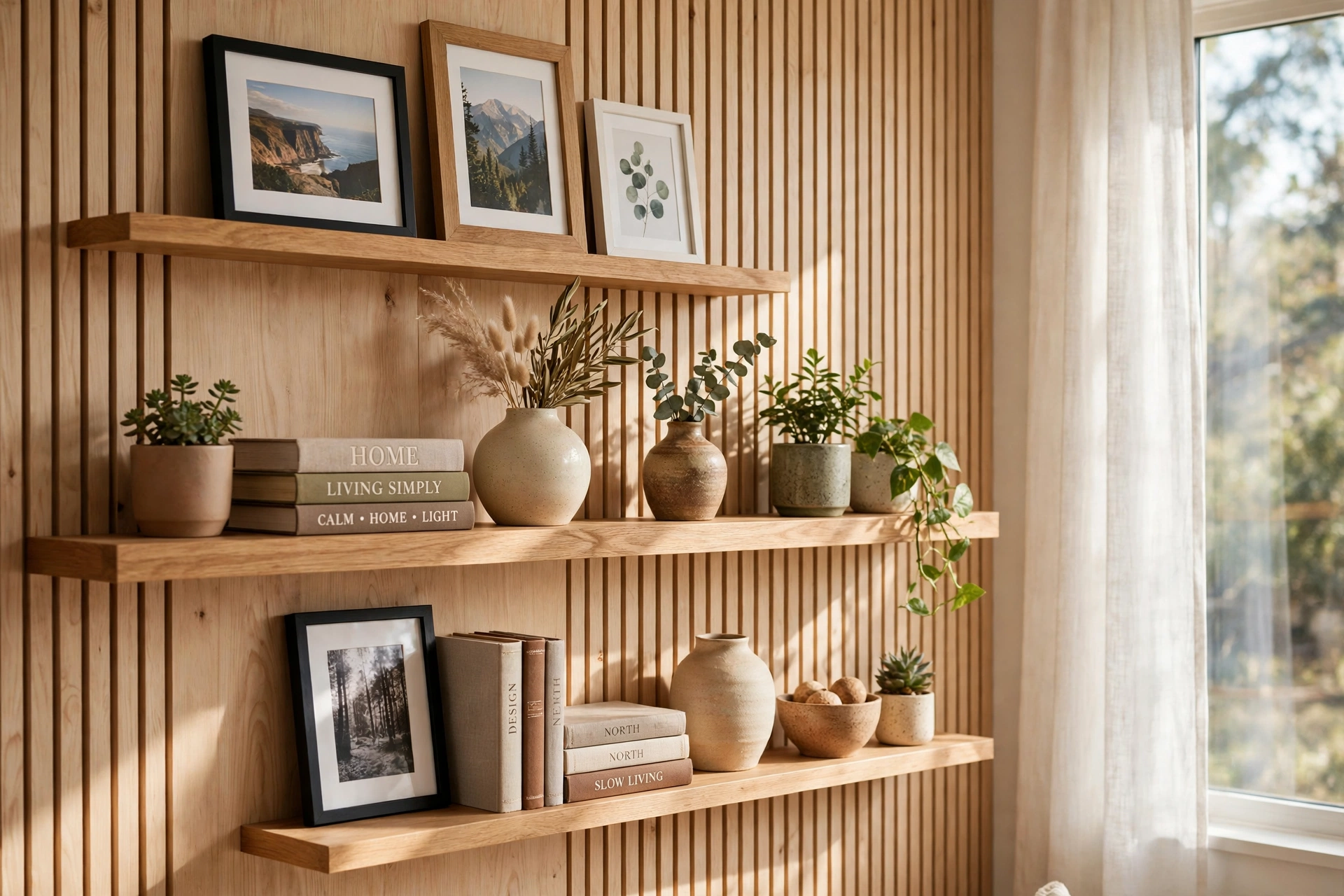
Add Shelves and Ledges That Hold More Than Frames
Floating shelves and picture ledges turn a flat wall into working storage, and a standard picture ledge 3.5 to 4.5 inches deep holds frames up to 24 inches tall with no extra holes when you swap art. Depth decides the job. Ledges stay shallow on purpose, built for leaning frames, small plants, and paperbacks. Floating shelves run 8 to 12 inches deep and carry real loads: dinnerware, book rows, storage baskets. Vertical spacing between shelves should land at 12 to 15 inches, enough for a 10 inch vase plus clearance. Two 36 inch ledges stacked above a desk give a renter a rotating gallery for under $60 in lumber and brackets. A loaded 48 inch bookshelf can pass 40 pounds, so at least one bracket or cleat must find a stud, and studs repeat every 16 inches along most interior walls.
Change the Wall Itself With Paneling, Trim, and Paint
Panel molding, board and batten, and wainscoting add architecture to a plain wall for the price of lumber and paint, and wainscoting looks correct at one-third of the wall height. Surface treatments solve the walls that art cannot: the long hallway, the stairwell, the room with no furniture against the wall. A 9 foot wall takes wainscoting at 36 inches, capped with a chair rail. Board and batten runs floor to ceiling or to two-thirds height, with vertical battens spaced 12 to 18 inches apart; a 12 foot wall with battens every 16 inches needs 10 battens and reads evenly from the doorway. Picture frame molding, thin trim boxes applied flat to drywall, delivers the paneled look of older homes for about $1 to $2 per linear foot of trim. Paint finishes the job in a weekend. One saturated accent wall behind a sofa grounds the room, and peel-and-stick wallpaper covers a rental wall with zero paste and a clean removal, if the lease forbids paint and nails alike.
Layer Texture With Baskets, Plates, Textiles, and Plants
Woven baskets, decorative plates, textiles, and wall plants add depth that flat art cannot, and a cluster of five to seven baskets in mixed sizes covers about a 4 foot section of wall. Texture is the missing layer in most rooms, since framed prints are all glass and flat planes. Few wall decor ideas change how a room feels this cheaply. A basket wall over a sideboard warms a dining room for the cost of thrift store finds, often $3 to $8 per basket. Decorative plates on wire hangers bring pattern to kitchens and breakfast nooks, arranged in a loose oval echoing the table shape. Macrame hangings and tapestries do double duty in echo-prone rooms, softening sound in a living room with hardwood floors and no rug. Wall-mounted planters trail pothos down a bathroom or kitchen wall, and the plant adds the one color no paint swatch matches exactly. Group odd numbers, three, five, or seven pieces, because odd groupings settle faster visually and need less measuring than even ones.
Hang Everything Safely: Hardware Matched to Weight
Hardware must match both the weight of the piece and the material of the wall, since a 30 pound mirror on a hook rated for 10 pounds will end up on the floor. Weigh the piece on a bathroom scale before you shop for anchors. Drywall alone holds far less than a stud does. French cleats, two angled metal or wood strips that lock together, spread heavy loads across a wide area and keep big pieces flush and level. Adhesive strips top out around 16 pounds for the largest pairs and fail sooner on textured or freshly painted walls. The table below matches common weight ranges to the hardware that actually holds them.
| Piece weight | On drywall alone | Into a stud | Recommended hardware |
|---|---|---|---|
| Under 5 pounds | Adhesive strips or one nail | One nail | Small picture hook or adhesive strip |
| 5 to 20 pounds | Plastic anchor rated 25 pounds | Wood screw | Sawtooth hanger or D-rings with anchor |
| 20 to 50 pounds | Toggle bolt rated 50 pounds or more | Lag screw | French cleat or two D-rings on separate anchors |
| Over 50 pounds | Not recommended | Lag screws into two studs | French cleat or picture rail system |
Mark stud locations with a stud finder and a strip of tape before committing to a layout, if the anchor piece weighs more than 20 pounds. Two smaller anchors spaced apart beat one large anchor for wide pieces, since the load splits and the frame cannot pivot. Felt pads on the bottom corners keep frames straight and protect paint.
Wall Decor Ideas by Budget
Paint, one large print, and secondhand frames deliver the largest visible change per dollar, while custom paneling and oversized mirrors sit at the top of the spending ladder. Under $50, a gallon of paint in an arch or color-block shape, a plate cluster from a thrift store, and frames you already own can finish one wall completely. Between $50 and $200, the money goes further on one anchor piece: a 48 by 36 inch canvas, a pair of picture ledges, or a 36 inch round mirror. Budgets above $200 open the structural options, board and batten on one wall, a full grid of nine matching frames with custom mats, or a mirror large enough to anchor a mantel. Spend on the wall you see from the doorway first. Guest rooms and hallways can wait, and they usually inherit the frames the main wall outgrows.
FAQs
How high should you hang a picture on a wall?
Center the piece at 57 inches from the floor, the standard galleries use. Over a sofa or console, hang it lower so the bottom edge sits 6 to 8 inches above the furniture.
How far apart should gallery wall frames be?
Keep 2 to 3 inches between every pair of frames. Even gaps make separate pieces read as one group, while gaps past 5 inches break the arrangement into unrelated singles.
What size art should go above a sofa?
Choose art, or a gallery group, that spans about two-thirds of the sofa width. For an 84 inch sofa, target roughly 56 inches of total width and leave the rest as breathing room.
How do you decorate a very large blank wall?
Scale up instead of multiplying small pieces. One 60 by 40 inch canvas, a nine-frame grid, board and batten paneling, or a pair of 48 inch ledges each covers serious square footage with one decision.
What are the best wall decor ideas for a small room?
Mirrors facing a window return light and double visual depth. Shallow picture ledges add display space at 4 inches deep, and one large piece beats several small ones, which can make tight walls feel busy.
Can you hang heavy art on drywall without studs?
Yes, within limits. Toggle bolts rated at 50 pounds or more hold most framed pieces, and a French cleat spreads the load wider. Past 50 pounds, lag screws into studs become the safe answer.
How much does a gallery wall cost?
A nine-frame grid using bulk frame packs and home-printed photos runs $60 to $120. Custom framing pushes the same wall past $500, so the frames, not the art, decide the budget.
Conclusion
Every method in this guide, gallery grids, oversized canvases, mirrors, ledges, paneling, and woven texture, obeys the same three measurements: 57 inches on center, two-thirds of the furniture width, and 2 to 3 inches between grouped frames. Pick one wall, tape the outline, and hang the anchor piece first, since the smaller pieces arrange themselves around a well-placed anchor. Budgets stretch further on one right-sized piece than on five almost-right ones. A standard interior wall hides a stud every 16 inches, and the anchor matched to your piece’s weight matters more than the art itself.