

Most nursery decor girl guides start with finished photos and skip the decisions behind them. Parents still face the same open questions after the photo tour ends. Which theme comes first? Paint, furniture, and budget follow in a fixed order, and that order removes most of the guesswork. Decor goes last because prints and textiles cost little to swap. Safety rules run through every step rather than one crib purchase. Rooms planned this way suit a newborn on day one and still work for a toddler two years later. Consider the math on a real room: $1,850 covers a convertible crib, a glider, paint, one wallpaper wall, and storage inside a 10 by 12 foot (3.0 by 3.7 m) nursery.
Which Girl Nursery Themes Do Parents Choose Most in 2026?
Wildflower, blush vintage, boho, and coastal themes lead girl nursery choices in 2026 because each theme pairs soft color with natural texture and standard furniture sizes.
Retailers group nursery decor girl products by theme because a theme limits every later decision. Fabric, paint, and art all answer to one reference point. Shoppers who skip the theme step usually buy pieces that fight each other. Start with the three styles below and commit before ordering anything.
Wildflower and Botanical Prints
Wildflower prints hold the top spot for the second straight year. Dusty rose, sage, and cream petals scale well on one accent wall behind the crib. Peel-and-stick rolls make the look renter friendly: a standard roll measures 20.5 inches (52 cm) wide and covers about 30 square feet (2.8 square m). Order one extra roll, if your wall has windows or a closet door cutting into the surface. Watercolor peonies read softer than cartoon florals, and the print still suits a four year old. Natural wood furniture keeps the pattern from turning the room into a garden diorama.
Soft Blush Vintage
Vintage blush rooms layer scalloped edges, pleated lamp shades, and aged oak finishes. Heirloom pieces anchor the style better than new replicas do. A grandmother’s refinished dresser, for example, adds real age that factory distressing can’t copy. Parents add bows in fabric and hardware rather than paint, and bows leave the room in one afternoon once tastes change. Brass curtain rods and picture frames warm the pale palette without darkening it.
Boho Rattan and Coastal Calm
Boho and coastal styles share rattan, cane webbing, and woven cotton, so the two looks blend in one room without friction. Rattan shows up on changer baskets, lamp shades, and the classic peacock chair in the corner. Coastal versions swap terracotta for sea glass blue and sandy beige. Texture does the decorating work in both styles, which keeps walls simple and repainting cheap. Jute rugs belong under the glider only, since rough fibers irritate crawling knees on open floor.

What Colors Work Best in a Baby Girl Nursery?
Blush and sage, soft blue, and warm neutrals form the three palettes that dominate girl nurseries in 2026.
Three palettes lead nursery decor girl searches this year, and none of them requires a pink wall. Designers apply the 60-30-10 rule: 60 percent base color, 30 percent secondary color, and 10 percent accent. Paint chips decide more rooms than furniture does, so test two sample pots on the wall before buying gallons. North facing rooms cool every color down, while south facing rooms warm colors up.
Sample boards settle arguments fast. Tape paint chips beside fabric swatches and flooring offcuts, then live with the board for 48 hours before ordering anything. Morning light exposes yellow undertones that store lighting hides. Two sample pots cost about $12 total, a small fee against a $180 repaint.
Blush Paired With Sage
Blush and sage is the signature pairing of 2026. Benjamin Moore First Light 2102-70, a pale blush pink, reads soft peach under warm evening light. Sage green on the dresser or closet doors balances the sweetness. Gold hardware counts as the 10 percent accent in most blush rooms. Test the pair together, if your room gets strong afternoon sun, because blush can flare orange at golden hour.
Soft Blue Instead of Pink
Soft blue has moved from boy territory into girl nurseries with full force. Sherwin-Williams Rainwashed SW 6211, a blue green gray, pairs with white furniture and blush textiles. Florals keep the blue feminine: one watercolor print above the crib does the job. Blue walls also hide scuffs better than white during the toddler years. Renters can copy the palette with blue bedding and art instead of paint, if the lease bans wall color.
Warm Neutrals as the Base
Warm white walls give parents the longest runway. Benjamin Moore White Dove OC-17 stays warm without turning yellow under light-emitting diode (LED) bulbs. Neutral walls accept any theme swap later: wildflower today, woodland at age two, and a reading nook at age four. Texture supplies the interest that color withholds, through boucle cushions, linen curtains, and a wool blend rug. Resale value plays a role too, since neutral nurseries need no repainting before a home sale.
How Do You Plan the Layout and Furniture First?
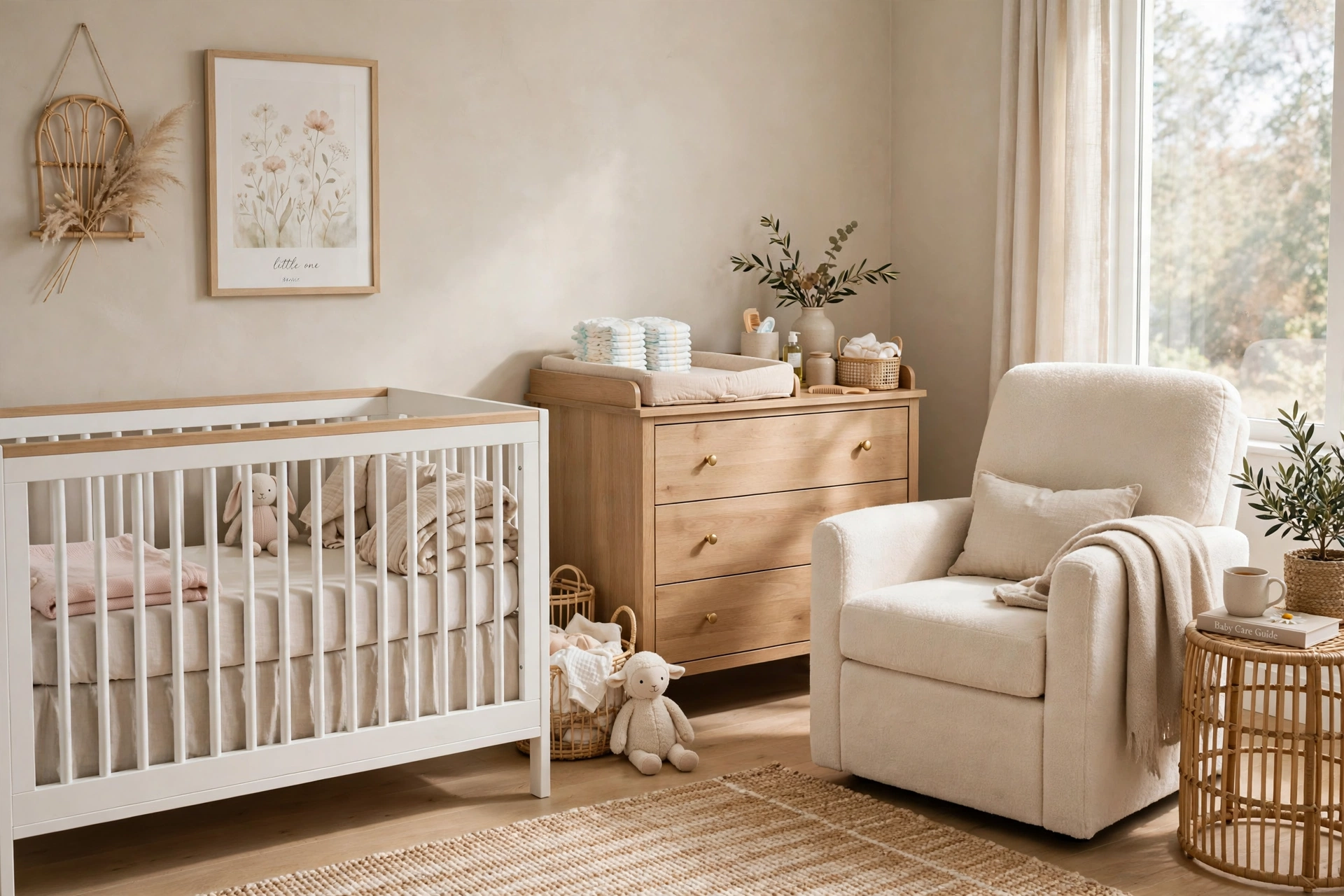
A crib, a dresser with a changing tray, a glider, and a rug form the four furniture anchors in a girl nursery layout.
Furniture placement comes before wall decor on every competent plan. Measure the room and tape the crib outline on the floor with painter’s tape before ordering. Door swings and window positions eliminate more layouts than taste does. Keep the crib away from windows, since cords, drafts, and direct sun all reach a baby through glass.
The Four Anchor Pieces
Convertible cribs lead the anchor list because one frame serves from birth to the toddler bed stage. Dressers with removable changing trays rank second: the tray comes off, and the dresser stays for a decade. Gliders with a high back support night feeding posture better than low lounge chairs. Position the glider within arm’s reach of a side table, if night feeds will happen in the nursery. The rug goes down first in practice, since furniture legs pin its corners flat.
Sizes and Clearances That Fit US Rooms
Standard crib mattresses measure 52 by 28 inches (132 by 71 cm), and the crib frame adds about 2 inches (5 cm) on each side. Rooms under 120 square feet (11.1 square m) fit a 5 by 8 foot (1.5 by 2.4 m) rug. Larger rooms take an 8 by 10 foot (2.4 by 3.0 m) rug under both the crib and the glider. Leave 24 inches (61 cm) of open floor between the dresser and the crib for changing access. Changing trays sit 36 to 38 inches (91 to 97 cm) high, a range that protects most parents’ backs during the roughly 2,500 diaper changes of the first year.
What Safety Rules Govern Every Decor Choice?
The American Academy of Pediatrics (AAP) requires a bare crib with a firm, flat mattress and no bumpers, pillows, blankets, or stuffed animals in the sleep space.
Safety standards narrow nursery decor girl choices before style enters the discussion. Federal rules cover the crib itself, while pediatric guidance covers bedding and room setup. Decor that conflicts with either rule set leaves the room, no matter how good the piece looks in photos.
The Bare Crib Rule
Bare is best is the AAP shorthand, and bare means a fitted sheet only. Loose blankets, crib bumpers, and plush toys raise suffocation and strangulation risk during unsupervised sleep. Cribs sold in the United States must meet Consumer Product Safety Commission (CPSC) standards, including slats spaced no more than 2 3/8 inches (6 cm) apart. A soda can must not pass between the slats, if you want a fast home test of an older crib. Wearable blankets replace loose covers for warmth, and room temperature between 68 and 72 degrees Fahrenheit (20 and 22 degrees Celsius) removes the need for extra layers. Certification from the Juvenile Products Manufacturers Association (JPMA) on the crib label confirms third party testing.
Anchoring, Cords, and Paint
Dressers tip, and anchoring straps cost under $10 per unit. Screw the strap into a wall stud, not drywall alone, if the dresser holds a changing tray on top. Window coverings in US nurseries must be cordless or use inaccessible cords under current federal rules, because looped cords strangle climbing toddlers. Paint matters as well: low volatile organic compound (VOC) paint under 50 grams per liter (g/L) limits fumes in a room where a newborn sleeps 16 hours a day. Finish painting at least two weeks before the due date, if the schedule allows, so the finish cures fully. Wall art above the crib needs a frame anchored into a wall stud, and frames sit flush and locked so nothing drops into the crib.
How Much Does a Girl Nursery Cost in the United States?
A girl nursery costs between $500 and $6,500 in the United States, with the crib, glider, and dresser taking 55 to 70 percent of the total.
A nursery decor girl budget splits cleanly into three tiers for most US households. Furniture prices drive the tiers, while decor spending stays nearly flat across all three. Big-box convertible cribs start near $199, and designer cribs pass $1,200 for the same sleep function. Secondhand savings apply to dressers and gliders, never to cribs or mattresses, since safety standards and hygiene rule out used sleep surfaces.
| Budget tier | Total cost | Furniture | Decor and textiles | Paint and walls |
|---|---|---|---|---|
| Starter | $500 to $900 | $300 to $500 | $120 to $250 | $80 to $150 |
| Mid-range | $1,200 to $2,500 | $800 to $1,600 | $250 to $550 | $150 to $350 |
| Designer | $4,000 to $6,500 | $2,600 to $4,400 | $800 to $1,400 | $600 to $700 |
Spending order matters more than tier. Buy the crib and mattress first, the glider second, and the dresser third. Decor purchases wait until the anchors stand in the room, because rug size and curtain length depend on final furniture positions. Parents who reverse the order often own beautiful curtains that fit no window in the finished layout.
Which Wall Decor and Textiles Finish the Room?
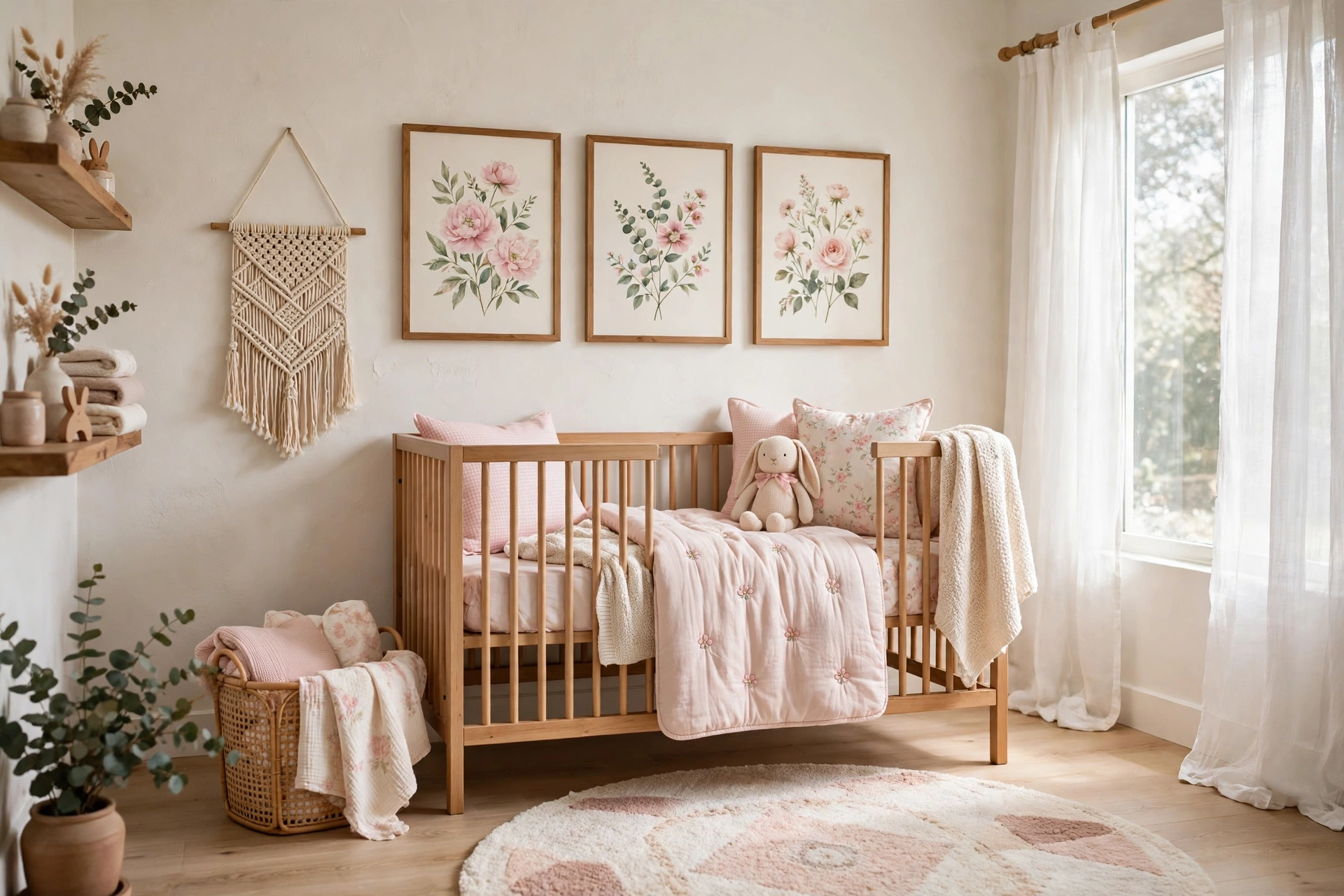
Peel-and-stick wallpaper, a framed name sign, blackout curtains, a dimmable lamp, and textiles layered outside the crib finish a girl nursery.
Walls carry the theme so furniture can stay plain. One wallpapered wall behind the crib sets the scene, and peel-and-stick panels remove cleanly at lease end. Name signs remain the most requested personal touch: wooden letters 10 to 14 inches (25 to 36 cm) tall read clearly above a standard crib. Anchor every letter into the wall, if the sign hangs over the sleep space, and pull the crib 2 inches (5 cm) off the wall as a drop guard. Gallery walls belong on the feeding side of the room, where the baby faces art during awake time instead of sleep time.
Blackout curtains protect daytime naps. Panels at 84 inches (213 cm) suit standard 8 foot (2.4 m) ceilings and puddle slightly on carpet. Pair blackout panels with a dim lamp for night feeds: a bulb near 2,700 kelvin gives warm light that won’t fully wake a feeding parent. Textiles add the softness that safety rules ban from the crib itself. Quilts hang on the wall or drape the glider, swaddles stack in open baskets, and the rug supplies floor level softness for tummy time. Woven baskets in three sizes, roughly 12, 15, and 18 inches (30, 38, and 46 cm) across, sort blankets, toys, and laundry without lids that trap fingers.
Outlet covers and cord shorteners finish the wall work in under an hour. Neither item photographs well, and both belong on the checklist before the baby arrives.
How Do You Make the Nursery Grow With Her?
A convertible crib, removable wall decor, and a neutral furniture base carry a girl nursery from birth to age four without a second full redesign.
Growth planning saves the cost of nursery number two. Conversion rails turn most convertible cribs into toddler beds for $80 to $150 per kit, and the same frame later accepts a full size headboard on many models. Removable decals and peel-and-stick wallpaper retire the baby theme in an hour, while painted murals demand primer and two coats to erase. Swap textiles instead of furniture at each stage: crib sheets give way to a duvet, and the glider moves to a reading corner with a small bookshelf beside it. A $180 refresh at 24 months, covering new art, a toddler pillow for the converted bed, and low storage bins, updates the room for a fraction of the original $1,850 build. The room keeps its original paint, rug, and dresser through the whole sequence.
Frequently Asked Questions
What is the most popular girl nursery theme in 2026?
Wildflower leads 2026 searches. Dusty rose and sage florals pair with natural wood furniture, and the print still suits a toddler room after the crib converts to a bed.
Can a girl nursery skip pink entirely?
Yes. Soft blue, sage green, and buttercream yellow all read feminine beside scalloped edges, floral prints, and brass hardware, and each palette pairs with standard white or oak furniture.
When should parents start decorating the nursery?
Week 20 of pregnancy is a practical start. Paint needs two weeks to cure before the due date, and furniture delivery runs four to eight weeks for popular crib models.
How big should a nursery rug be?
A 5 by 8 foot (1.5 by 2.4 m) rug fits rooms under 120 square feet. Rooms above that size take an 8 by 10 foot (2.4 by 3.0 m) rug under the crib and glider.
Are crib bumpers safe in a decorated nursery?
No. The American Academy of Pediatrics advises against bumpers, and federal law bans padded crib bumpers in the United States. A fitted sheet on a firm, flat mattress is the complete bedding set.
What paint finish suits nursery walls?
Eggshell or satin finishes wipe clean without the glare of gloss paint. Low-VOC (volatile organic compound) formulas under 50 grams per liter cost $45 to $65 per gallon at major US home stores.
How much wall clearance does a glider need?
Allow 30 inches (76 cm) between the glider back and the wall for a full recline. Side clearance of 12 inches (30 cm) lets a parent stand up while holding the baby.
Conclusion
Order decides the outcome of a nursery project more than taste does. Theme first, palette second, furniture third, and decor last keeps spending pointed at the pieces a baby actually uses. Parents who follow that sequence avoid the classic failure: a beautiful room with a crib wedged against a window. Every rule in this guide traces back to a measurement, a federal standard, or a pediatric guideline rather than a trend forecast. A nursery decor girl plan built on those fixed points survives contact with real life, midnight feeds included. The finished room holds one theme, one palette, four furniture anchors, and a crib that stays bare for every sleep.