Modern decor works best when you treat it as one system repeated across the whole home. A single room done in isolation always feels like a showroom corner. The same palette ratio, furniture proportions, and lighting rules, applied room after room, make even a modest house feel deliberate. You’ll find the system below in the order you should apply it: palette first, furniture second, materials and light after that, art and budgets last. Each rule comes with the numbers the photo galleries leave out.
What Modern Decor Actually Means
Modern decor is a defined style built on clean lines, honest materials, and pieces that each perform a clear job in the room.
The style took shape in the early to mid 20th century, shaped by the Bauhaus school in Germany and by Scandinavian designers who favored function over ornament. Its guiding rule, form follows function, still decides what belongs in a room today. People often confuse modern with contemporary, and the difference matters when you shop. Contemporary simply means whatever is trending this year, so a contemporary room can look dated by next spring. Modern refers to the fixed rule set, which is why a walnut credenza designed in 1958 still sits comfortably in a 2026 living room. You are not chasing a trend cycle. You are buying into proportions and materials that have already survived seventy years of taste changes, and that track record is exactly what makes the style a safe place to spend real money.

Start With the Palette: 60 Percent Neutral, 30 Percent Support, 10 Percent Accent
A modern palette places a warm neutral on about 60 percent of the room, a supporting tone on 30 percent, and one accent color on the final 10 percent.
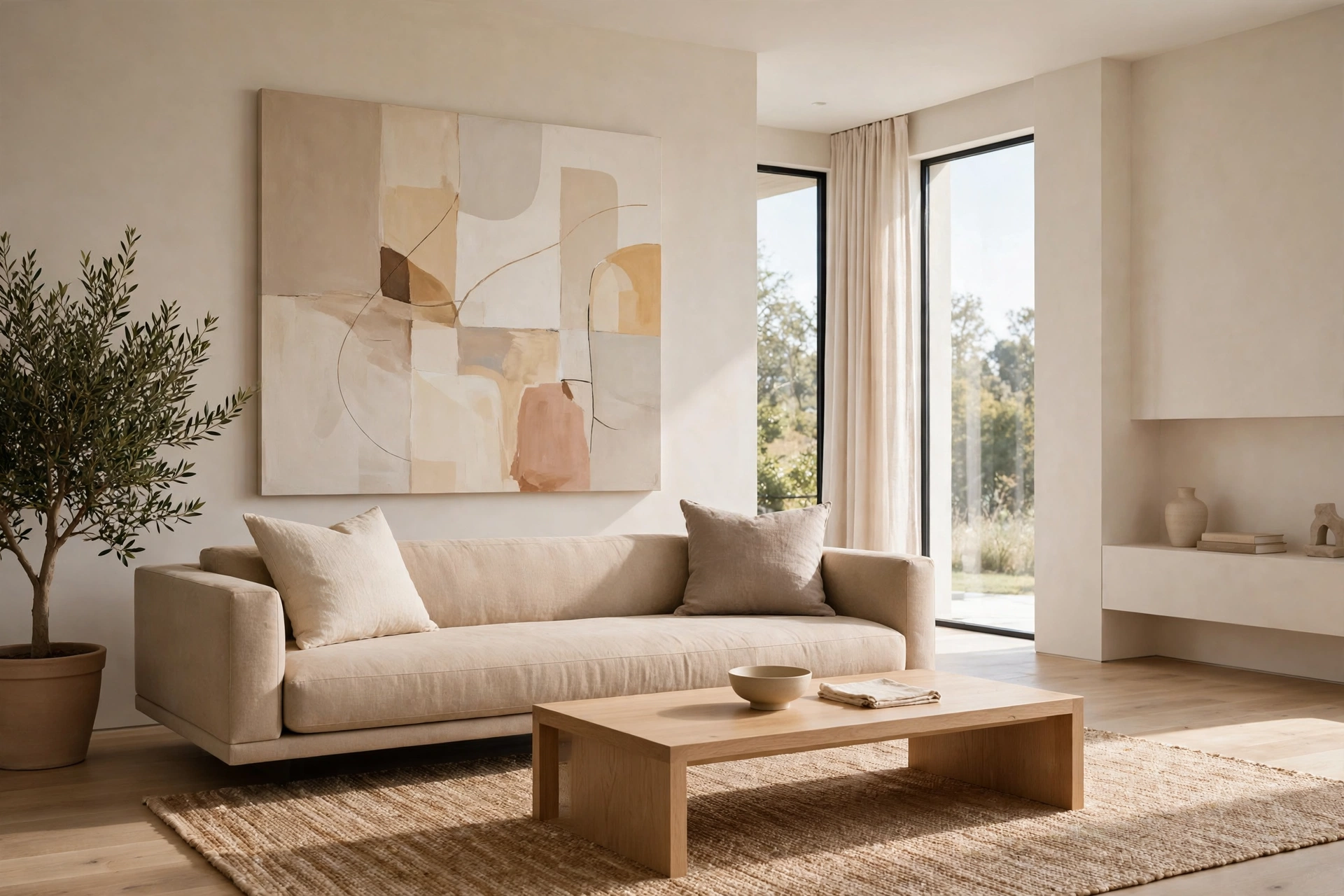
Walls and the largest upholstery pieces carry the 60 percent, and warm whites do that job better than stark whites. Benjamin Moore White Dove (OC-17) is the shade designers reach for most, because it reads clean in daylight and stays soft under evening lamps. The 30 percent layer comes from wood tones, greige or pale gray upholstery, and the rug. Sherwin-Williams Accessible Beige (SW 7036) on a sofa, paired with a white oak floor, lands squarely in that supporting band. Accent color then appears in one chair, one piece of art, or a pair of cushions, and nowhere else. Rust, ochre, and a deep midnight blue all work as the single accent. Black plays a different role in the system: it acts as line work, showing up in picture frames, lamp stems, and cabinet pulls to sharpen the neutrals around them. Choose your accent last, if the sofa, rug, and wall color are already settled in the room.
Furniture Lines: Low, Long, and Raised on Legs
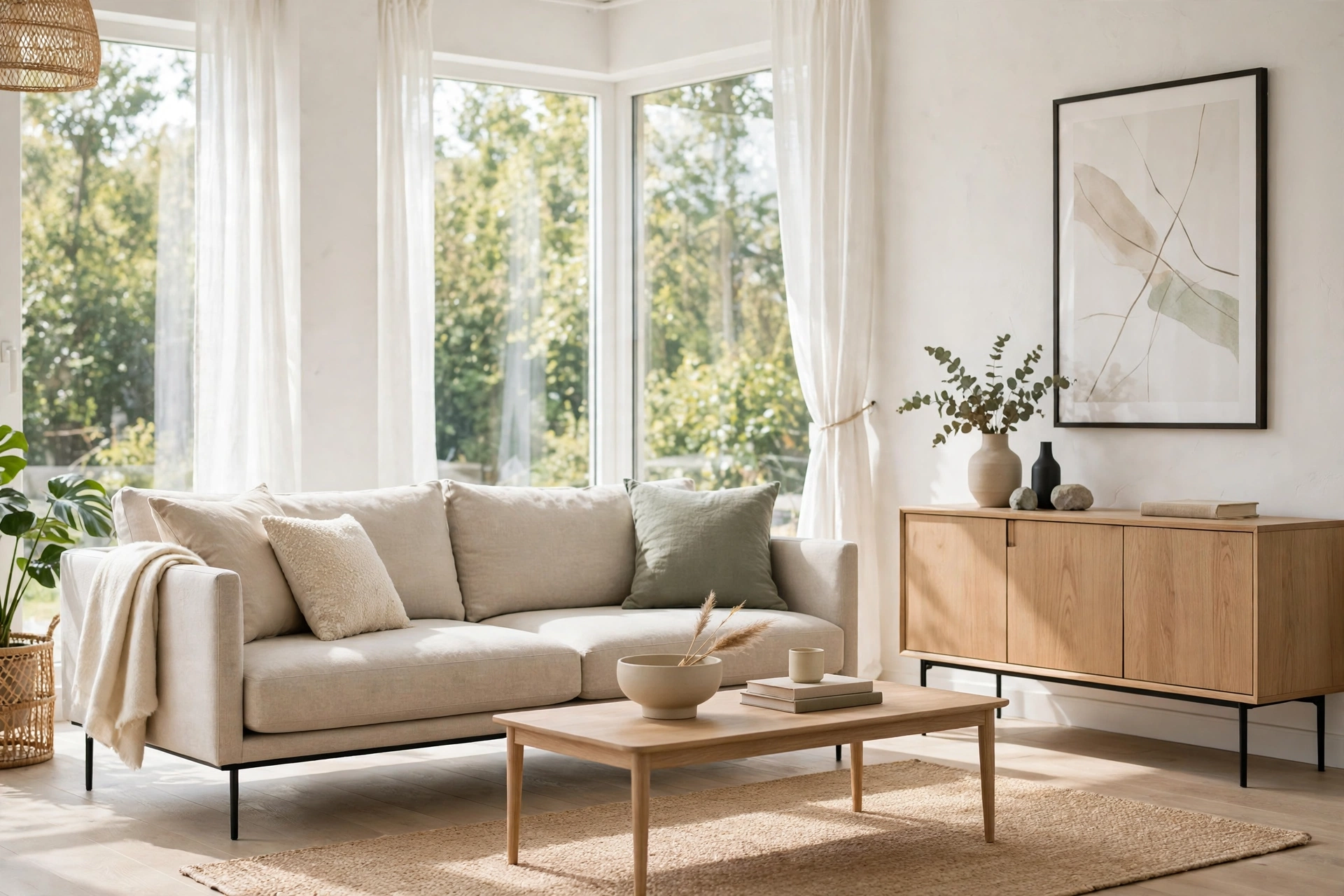
Modern furniture sits low, stretches long, and stands on visible legs that keep the floor visible beneath each piece.
Seat height tells the story fastest. A modern sofa seat sits around 17 inches high with a back near 32 inches, while traditional sofas often run 20 inches and 38 inches on the same measurements. Legs matter just as much: a credenza raised on 8 inch tapered legs lets light travel under it, and the room reads larger without gaining a single square foot. Spacing has its own numbers. Leave 16 to 18 inches between the sofa edge and the coffee table, enough for legs to pass and close enough to set down a drink. Picture an 84 inch low-profile sofa facing a 48 inch coffee table in a 12 by 16 foot living room, and the proportions click immediately. Matching furniture sets fight the system, since identical pieces flatten the contrast modern rooms depend on. Buy the anchor piece first, a sofa in the living room or a table in the dining room, and let everything else be chosen against it.
Materials: Pair Every Smooth Surface With a Natural Texture
A modern room stays warm when glass, lacquer, and steel sit beside at least three natural textures, such as wood grain, woven fabric, and stone.
Flat surfaces alone are the reason some modern rooms feel like offices. Texture is the correction, and it follows a simple discipline: repeat one wood tone in at least three places. A walnut coffee table, walnut picture frames, and a walnut side chair tie a room together more firmly than any accent color can. Travertine has become the stone of the moment for side tables and lamp bases, because its pitted surface breaks up smooth lacquer without adding pattern. Boucle upholstery does the same job on seating, and a single boucle chair can carry the texture load for an entire seating group. Walls can join in too. Limewash paint gives a flat wall a soft, cloudy movement for the price of one can, and fluted wood paneling behind a console adds shadow lines that read as architecture. Keep metals to two finishes per room, blackened steel and brushed brass for example, and the scheme stays calm instead of competing.
Lighting in Three Layers, With Numbers
Modern lighting combines ambient, task, and accent light in every room, and each layer runs on its own switch or dimmer.
One ceiling fixture cannot do all three jobs, which is why single-source rooms feel harsh by evening. Start with the ambient layer and size it by area: living spaces need roughly 20 lumens per square foot, so a 12 by 16 foot room calls for about 3,800 lumens spread across fixtures. Bulb color matters as much as brightness. Choose light-emitting diode (LED) bulbs at 2700 kelvin (K), the warm end of the scale, for living rooms, dining rooms, and entries, and save 3000K to 4000K for kitchen task zones. Dining pendants follow two hard numbers. The bottom of the fixture should hang 30 to 36 inches above the tabletop, and the fixture itself should measure about 12 inches narrower than the table, so a 42 inch wide table takes a pendant near 30 inches across. Accent light finishes the system: a picture light over the main artwork or a track head aimed at a textured wall gives the room its evening depth. Dim the ambient layer to half after dinner, if your fixtures sit on dimmers, and the same room shifts from work mode to rest mode in seconds.
Art at Full Scale
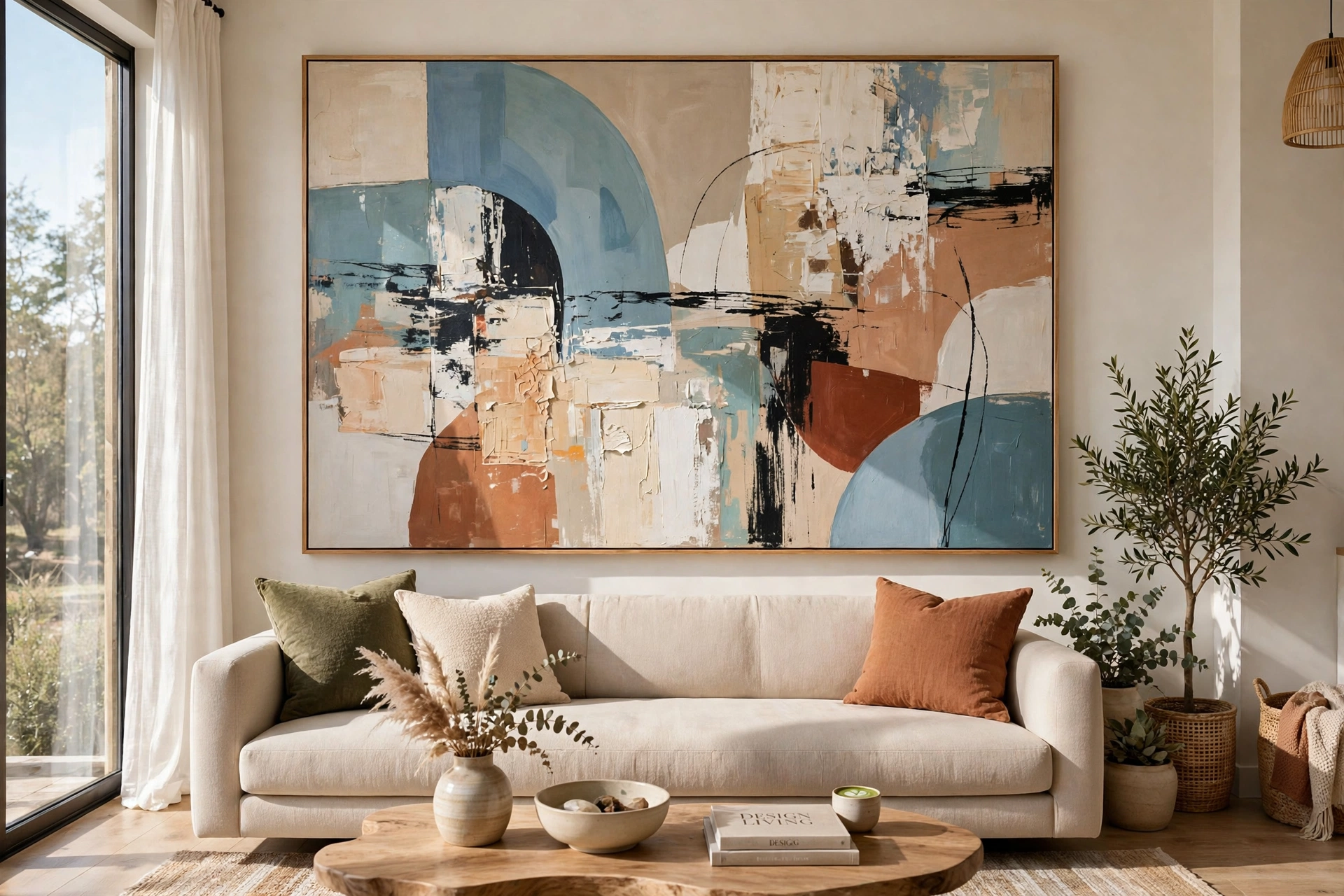
One large piece of art, sized to the furniture beneath it, gives a modern room its focal point and its color discipline.
Scale is where most rooms fail quietly. The working rule: art above a sofa or sideboard should span two thirds to three quarters of that furniture’s width. An 84 inch sofa therefore wants a piece, or a grouped arrangement, between 56 and 63 inches wide, with its center hung at 57 inches from the floor. A single 40 by 60 inch abstract canvas satisfies that math over most sofas and costs less than the six small frames it replaces. Grids still belong in modern rooms, provided the gaps stay even at 2 to 3 inches so the set reads as one object. Subject matter stays simple: abstracts, monochrome photography, and single bold shapes hold up against clean-lined furniture, while busy gallery walls of mixed small prints pull the eye in too many directions. Let the art carry the accent color from your palette, if the furniture is already neutral, and the 10 percent accent rule fulfills itself without another purchase.
Room-by-Room Notes
The palette, furniture, and lighting rules remain identical in every room of the house, and only the anchor piece changes.
Living Room
Anchor the room with the rug before anything else arrives. An 8 by 10 foot rug is the minimum under a standard sofa grouping, and the front legs of every seat should rest on it. A low media console, 20 to 24 inches high, keeps the long horizontal line the style depends on. One sculptural armchair earns the accent slot here.
Dining Room
Rectangular tables suit long rooms, and round tables serve square ones better, because traffic lanes stay even on all sides. Center the pendant by the numbers from the lighting section, and hang it before the table’s final position is set. A sideboard around 18 inches deep stores linens without crowding chairs, and its top is the natural home for the room’s one large artwork.
Entry
First impressions get set in about 40 square feet. A slim console, 30 to 36 inches wide and no deeper than 12 inches, plus a round mirror above it, covers most entries completely. Add one tray for keys and one closed basket for shoes, and the space stays clear. The entry should preview the palette used deeper in the home, so repeat the main wood tone here.
Kitchen
Flat-front slab cabinets are the modern standard, since raised panels collect visual noise and grease in equal measure. Long bar pulls, 6 to 10 inches, suit the horizontal lines better than round knobs. Counter stools with simple silhouettes and no arms slide fully under a 36 inch counter overhang, and open shelving works only when it holds one repeated set of dishes, not a mixed collection.
Bedroom, Briefly
Keep the same system and soften every setting: the softest neutral on the walls, an upholstered headboard as the anchor, and two matching lamps for symmetry. One short section is all the bedroom needs here, since a full modern bedroom guide deserves its own page.
Budgets: What to Buy First at Every Level
Lighting and the rug come first, because those two layers fix the proportions of a room before any furniture is replaced.
Accessories bought early almost always get replaced, while a correctly sized rug and layered light survive every later decision. The table below shows where each budget tier should go in one living room, and the same order holds in dining rooms and entries with the anchor piece swapped.
| Budget tier | First buys | What actually changes |
|---|---|---|
| Starter, about $300 | Two plug-in lamps, one large framed print, cushion covers in the accent color | Light softens, and the palette appears on the sofa |
| Mid, about $1,500 | Correct-size rug, one pendant or arc lamp, limewash paint for one wall | Proportions land, and the walls gain texture |
| Full room, about $5,000 | Anchor sofa or dining set, large-scale art, hardwired lighting on dimmers | The room reads finished rather than decorated |
Notice what never appears in the first buys: small decor objects. A $1,500 budget spent on a rug and a pendant transforms a room more than the same money scattered across twenty accessories, because the eye judges a room by its largest surfaces and its light. Renters follow the identical order, if every purchase stays plug-in, peel-and-stick, or freestanding. Save the splurge for the anchor piece, since that is the item you will look at daily for a decade.
FAQs
What is the difference between modern and contemporary decor?
Modern decor follows a fixed rule set from the mid 20th century: clean lines, natural materials, and function first. Contemporary decor means whatever is trending right now, so its look changes every few years.
What colors work best in modern decor?
Warm whites, greige, pale gray, and wood tones form the base, following the 60-30-10 split. One accent, such as rust, ochre, or midnight blue, covers the final 10 percent through art, cushions, or a single chair.
How do I make modern decor feel warm instead of cold?
Texture does the work. Add boucle or linen upholstery, a wool rug, and one repeated wood tone, then set bulbs to 2700K. Rooms feel cold when surfaces are all smooth and light comes from one ceiling fixture.
Can modern decor work in a small apartment?
Yes, and the style was practically built for small footprints. Furniture raised on legs, a tight repeated palette, and one large artwork instead of many small pieces make compact rooms read larger and calmer.
How much does it cost to redo one room in a modern style?
A starter refresh runs about $300 for lamps, art, and textiles. A mid-level redo with the correct rug and lighting lands near $1,500, while a full room with a new anchor piece reaches about $5,000.
Does modern decor work in a traditional house?
Yes, provided the architecture is left alone and the furnishings carry the style. Low-profile furniture, the modern palette, and layered lighting sit comfortably inside traditional trim, and the contrast between the two often looks intentional.
Conclusion
Start anywhere, but start with the measurements rather than the shopping cart. Paint one room in the 60-30-10 split, hang the art at the right height, and set the lamps on dimmers, and the system begins to prove itself within a weekend. Pieces can then arrive slowly, one anchor at a time, without the room ever losing its logic. A studio apartment and a five-bedroom house run on the identical numbers: art centered at 57 inches, pendants 30 to 36 inches above the table, and accent color held to 10 percent of the palette.