
Four decisions drive every successful modern bedroom: a restrained color palette, a low-profile bed, three layers of lighting, and storage that stays out of sight. Paint, bedding, and decor come after those four calls. Most rooms that feel almost modern miss on one decision only, usually lighting or storage, and fixing the weakest one changes the room fast.
Numbers matter here more than taste does. A queen bed measures 60 by 80 inches (152 by 203 centimeters) in every catalog. Walkways, rug sizes, and sconce heights follow the same fixed math, and the style follows once the math is right.
What Defines a Modern Bedroom?
Clean lines, flat surfaces, and a short list of repeated materials define a modern bedroom. Ornament stays off the furniture, and legs stay visible or disappear into a platform base. Each surface earns its place, because a modern room holds fewer objects and shows each one fully.
Designers trace the style to the decades between 1930 and 1965, when makers like Charles and Ray Eames replaced carved wood with molded plywood and steel. Period furniture still sets the proportions used now: low, wide, and horizontal. Picture a walnut platform frame, one wool rug, and two identical nightstands, with nothing in that trio needing decoration.
Restraint does not mean empty, though. Texture does the work that pattern does in other styles. A boucle accent chair against a flat plaster wall gives the eye plenty to read. Your own room probably needs subtraction before shopping, since most bedrooms carry two or three pieces too many.
Modern Versus Contemporary: What Is the Difference?
Modern names one fixed historical style, while contemporary names whatever is current in a given year. Confusing the two leads to mismatched purchases: a 2026 trend piece in a modern scheme makes the room argue with itself. Stick to the period rules, clean lines, natural materials, low profiles, and let accessories carry any current color you like.
Which Colors Work Best in a Modern Bedroom?
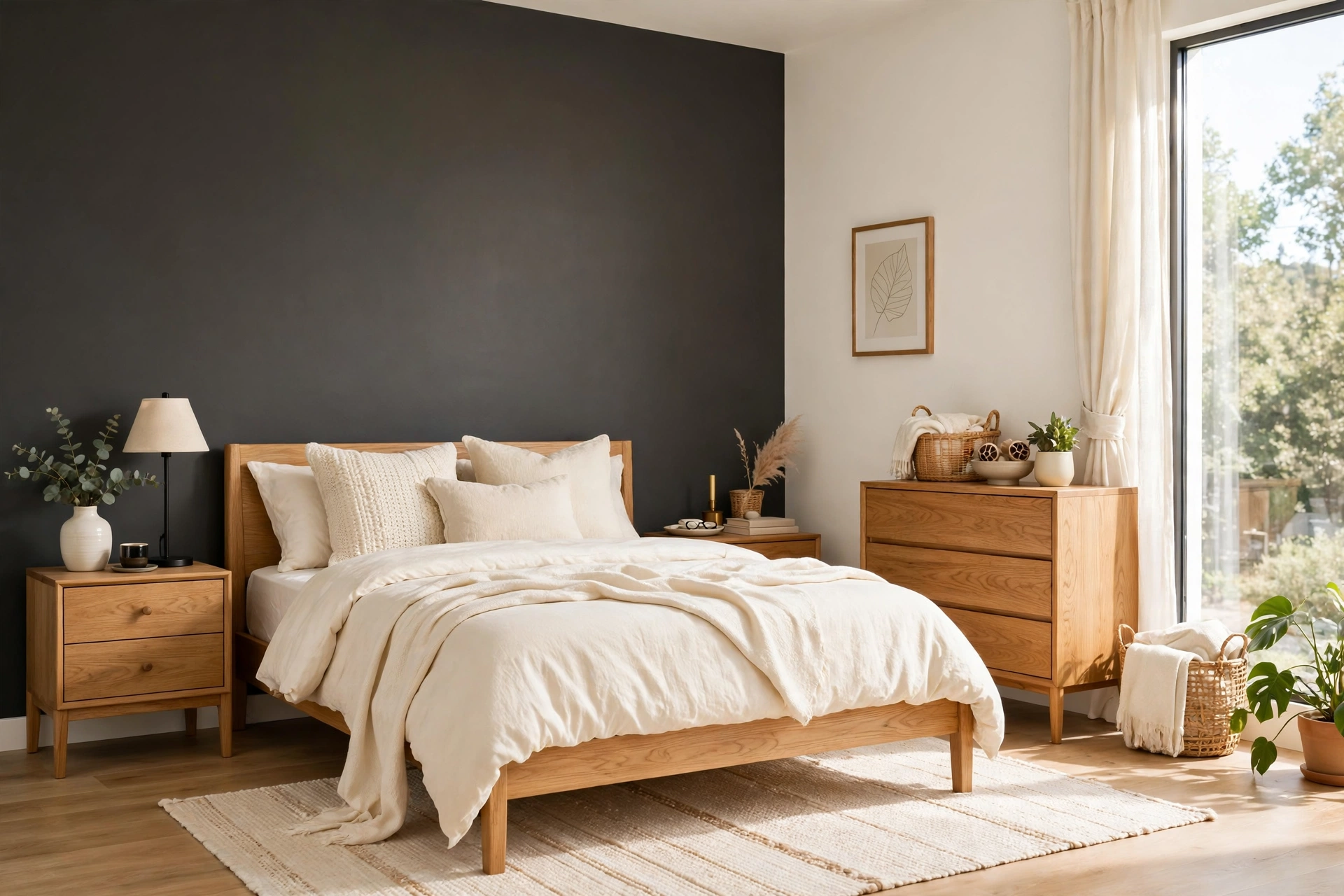
Warm whites and greige cover the walls in most modern bedrooms, and one deep accent color takes roughly 10 percent of the visible surfaces. The 60-30-10 rule keeps the balance honest: 60 percent base color, 30 percent secondary tone, 10 percent accent. Bedrooms that skip the accent read flat, and rooms that push the accent past 15 percent stop feeling calm.
Paint names remove the guesswork. Benjamin Moore White Dove OC-17 carries a Light Reflectance Value (LRV) of 83, so White Dove bounces most daylight back into the room. Sherwin-Williams Agreeable Gray SW 7029 sits at an LRV of 60 and reads warm under evening light. Buy a sample pot before committing to two gallons.
Warm Neutrals as the Base
Warm neutrals with a yellow or beige undertone keep modern rooms from feeling cold under north-facing light. Stark blue-white paints cause most of the complaints. Paint two 12 by 12 inch swatches, one warm white and one blue-white, and check both at 8 p.m. under your own bulbs; warmth wins in nine rooms out of ten.
Bedding should stay inside the same family. White sheets, an oatmeal duvet, and a camel throw read as layers, not clutter.
One Deep Accent Color
Navy, forest green, and charcoal work as the single deep accent, placed on the headboard wall, one chair, or the bedding foot. Benjamin Moore Hale Navy HC-154 is the proven pick for a headboard wall. Paint only the wall behind the bed. Four walls of Hale Navy shrink a 12 by 14 foot room visually, while one wall adds depth without the penalty.
Curtains offer a softer route: floor-length drapes in deep green frame the window and fill the accent quota. Don’t repeat the accent in more than three places, because repetition past three turns an accent into a theme.
How Do You Choose the Right Bed for a Modern Bedroom?
A low platform bed with a frame height of 10 to 14 inches (25 to 36 centimeters) sets the modern silhouette and anchors every other measurement in the room. Platform frames remove the box spring, so the mattress sits lower and the headboard line stays horizontal. Upholstered models soften the look; solid wood sharpens it.
Size the bed to the room before you fall for a frame. A queen at 60 by 80 inches fits any room wider than 10 feet. Kings at 76 by 80 inches (193 by 203 centimeters) need a room at least 12 feet wide to keep side walkways open. Couples in a 10 by 11 foot room sleep better on a queen with real walking space than on a king wedged wall to wall.
Headboard height changes the room’s proportions. Panels between 48 and 54 inches tall suit standard 8 foot ceilings. Taller headboards, 60 inches and up, belong in rooms with 9 or 10 foot ceilings. A channel-tufted headboard in ivory boucle, priced near $650 for a queen in 2026, shows how upholstery adds softness without adding pattern.
Add frame height to mattress depth, usually 10 to 14 inches, to get the final total. The sleeping surface should land between 22 and 25 inches off the floor. Anything higher reads traditional. Lower totals make the bed hard to leave in the morning.
What Layout Measurements Keep a Modern Bedroom Open?
Walkways of 24 to 30 inches (61 to 76 centimeters) on both sides of the bed keep a modern bedroom open, balanced, and easy to move through. Matching nightstands, matching lamps, and equal clearance on both sides tell the eye the room was planned. A lopsided layout breaks the effect faster than any wrong color can.
Nightstands follow two numbers. Width between 16 and 24 inches suits most rooms, and the top should sit level with the mattress surface, around 24 to 26 inches high. A nightstand 4 inches lower forces a nightly reach down for a phone or a glass of water.
Rug placement follows a fixed pattern. An 8 by 10 foot rug under a queen bed extends 18 to 24 inches past each side and about 12 inches past the foot. Bare feet land on wool instead of cold floor at 6 a.m., which is the entire point. A 5 by 8 foot rug disappears under a queen frame and reads as a mistake, so size up.
Dressers need 36 inches of open floor in front, measured with the deepest drawer fully open. Hallway-style gaps narrower than 24 inches anywhere in the room signal a piece that has to go or shrink.
How Should You Layer Lighting in a Modern Bedroom?
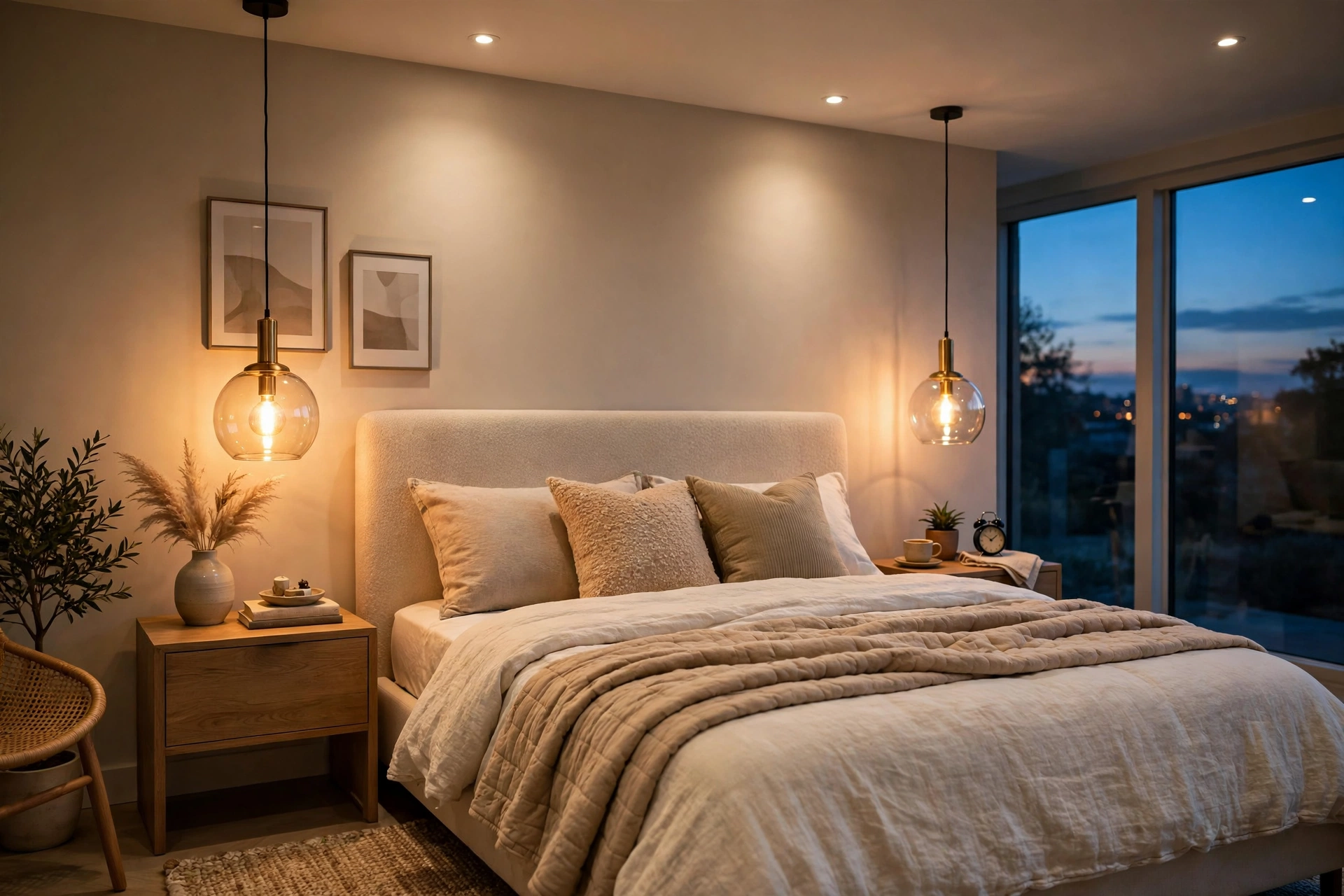
Three lighting layers on separate controls, ambient, task, and accent, give a modern bedroom even light with soft shadows at every hour. One ceiling fixture cannot do all three jobs: bedrooms lit from a single overhead source look flat at night and glare during the day. Layering fixes both problems with hardware installable in a weekend.
Start with color temperature, measured in Kelvin (K). Bulbs at 2700 K give the warm white light that suits skin tones and wood. Anything above 3500 K reads as office light. Buy every bulb at the same Kelvin rating, since mixed temperatures make one corner look dirty no matter how clean it is.
Ambient light needs 10 to 20 lumens per square foot. A 12 by 14 foot room covers 168 square feet, so the room needs 1,700 to 3,400 lumens in total. Two ceiling fixtures at 1,200 lumens each land inside that range. Dimmers on every circuit let you cut that output to 20 percent for winding down.
Ambient, Task, and Accent Layers
Ambient light fills the room, task light serves reading and dressing, and accent light outlines one feature such as a headboard or a slat wall. Recessed ceiling lights or a flush mount handle the ambient layer. Wall sconces at each side of the bed handle reading. A light-emitting diode (LED) strip behind the headboard handles the accent layer and doubles as a night light at low output.
Sconce position follows the pillow, not the wall. Mount each sconce 60 inches from the floor and 6 inches outside the mattress edge. Swing-arm models in matte black, sold in pairs near $120, let two readers aim light independently. Plug-in versions suit renters, because plug-in sconces need no wiring and leave no holes.
Smart bulbs add one useful trick: scheduling. Program bulbs to fade to 40 percent brightness at 10 p.m. and the room itself starts cueing sleep. Tunable-white models shift from 3000 K in the morning to 2200 K at night, tracking daylight.
Which Textiles Keep a Modern Bedroom Warm Instead of Cold?
Natural fibers in tone-on-tone layers, linen, cotton percale, and wool, keep a modern bedroom warm without adding pattern or clutter. Synthetics fight the style twice, since polyester shines under light and shiny surfaces read as cheap next to matte walls. Check fiber content first on any bedding label.
Percale cotton at a 300 to 400 thread count feels crisp and breathes through summer. Linen softens with every wash and carries a natural wrinkle that suits modern rooms, since the style tolerates texture but not prints. A washed linen duvet cover in oatmeal, around $130 for a queen set, delivers more warmth per dollar than any decorative pillow.
Layer in this order: fitted sheet, flat sheet, duvet, then one throw folded across the foot. Four layers read as intentional. Seven layers read as a hotel showroom. Two sleeping pillows per person plus one long lumbar pillow finish the bed, replacing the pile of small cushions older styles demand.
The floor needs one soft landing zone. A sheepskin or high-pile wool rug beside the bed, roughly 2 by 4 feet, warms the exact spot where feet land first. Linen curtains hung from 2 inches below the ceiling to the floor add the last layer and make 8 foot ceilings read taller.
How Do You Add Storage That Stays Hidden?
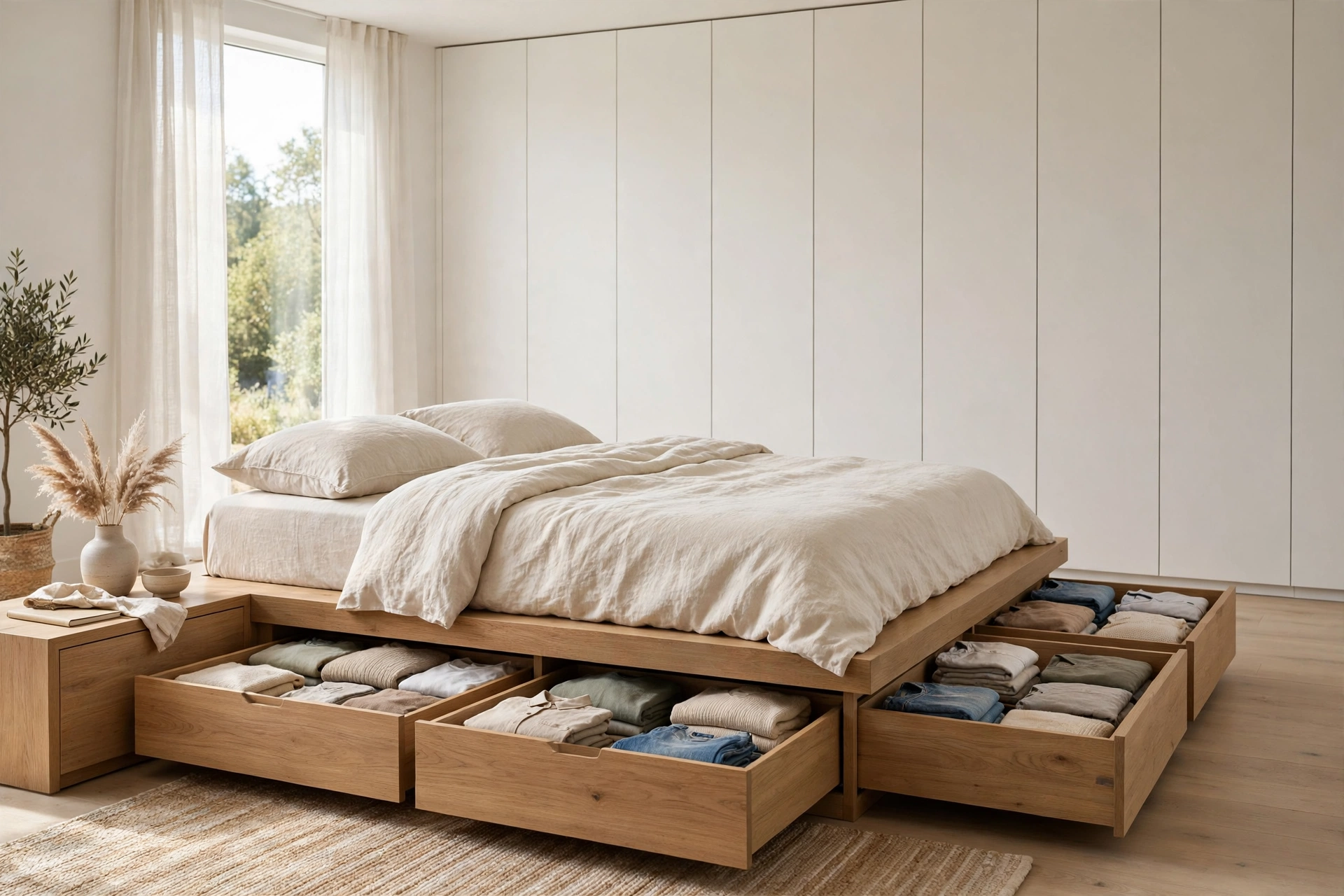
Flat-front wardrobes, under-bed drawers, and closed nightstand drawers hold the most in a modern bedroom while showing the least. Open shelves and visible rails fight the style, because modern rooms hide their working parts and show only objects placed by choice.
A full wall of fitted wardrobes with slab doors stores more than any dresser row. Standard wardrobe depth is 24 inches (61 centimeters), enough for hanging clothes on a rail. Push-to-open hardware removes handles and leaves one flat plane of color. Paint the doors to match the wall and an 8 foot run of storage nearly disappears.
Under-bed space is free storage most rooms waste. Two drawers at 30 by 20 by 6 inches under a queen frame swallow a full set of winter sweaters or the spare duvet. Frames with built-in drawers cost about $150 more than open frames. Rolling boxes cost less, near $40 a pair, and work with a frame you already own.
Nightstand drawers beat open nightstand shelves every time. Chargers, cables, books, and medication all vanish behind one drawer front. Cable clutter on display is the fastest way to undo a modern scheme, so route every cord behind furniture; a $25 in-drawer outlet kit turns one drawer into the charging station.
What Wall Treatments Fit a Modern Bedroom?
Flat matte paint, limewash, and narrow wood slat panels are the three wall treatments that fit a modern bedroom, and all three belong on the headboard wall only. One treated wall gives the room a focal point; four treated walls compete with the bed.
Limewash adds movement without pattern. The finish dries with soft cloud-like variation and contains low levels of volatile organic compounds (VOCs), which suits a room where you breathe for eight hours a night. Two coats over one wall of 120 square feet take one gallon of limewash paint, sold near $60 to $90 in 2026.
Slat panels bring the wood tone that modern rooms need. White oak slats at 2 inch spacing across an 8 foot headboard wall warm up white bedding instantly. Ready-made panel kits run $180 to $320 for that wall size. Renters get the same look from peel-and-stick slat wallpaper at about $2 per square foot, and the wallpaper leaves no trace when the lease ends.
Art follows one rule: one large piece beats a cluster of small frames. A single framed print at 36 by 48 inches above a dresser holds a wall on its own. Small frames belong in hallways, where people stand close enough to read them.
How Do You Style a Small Modern Bedroom?
A small modern bedroom works when the palette stays at three colors, the furniture rises on legs, and one wall carries the single focal point. Every rule from the larger sections applies here, with tighter measurements and a lower piece count.
Take a 10 by 10 foot room, 100 square feet, as the test case. A full-size bed at 54 by 75 inches saves 6 inches of width against a queen and returns that space to the walkways. Floating nightstands 12 inches wide free the floor on both sides. Legs on every piece, bed, dresser, chair, let light pass underneath and make the floor read as one unbroken plane.
Mirrors earn their keep here. A 24 by 36 inch mirror on the wall opposite the window roughly doubles the daylight reaching the bed. Glossy or mirrored wardrobe doors push the effect further, bouncing light instead of absorbing it the way matte doors do.
Skip the bench, skip the accent chair, and skip the floor lamp. A small room needs the bed, two nightstands, one dresser, and nothing else on the floor. The result feels deliberate rather than cramped, because empty floor is a design material in a modern room, not wasted space.
How Much Does a Modern Bedroom Makeover Cost in 2026?
A paint-and-bedding refresh costs $400 to $900, while a full modern bedroom makeover with new furniture costs $3,500 to $9,000 at United States retail prices in 2026. Labor explains most of the spread: painting one room yourself costs materials only, while a fitted wardrobe install adds $800 to $1,500 in labor. Spend on the bed and the blackout layer first, because both affect sleep the same night they arrive.
| Element | Budget Pick | Typical Cost | Upgrade Pick | Typical Cost |
|---|---|---|---|---|
| Paint, 2 gallons low-VOC plus supplies | Store brand matte | $90 to $150 | Benjamin Moore Regal Select | $160 to $220 |
| Bed frame, queen | Metal platform frame | $180 to $350 | Solid white oak platform | $1,200 to $2,500 |
| Bedding set, queen | Cotton percale set | $120 to $250 | Washed linen set | $300 to $600 |
| Rug, 8 by 10 foot | Flatweave wool blend | $180 to $350 | Hand-knotted wool | $600 to $1,200 |
| Lighting | Two plug-in sconces | $120 to $240 | Hardwired sconces plus LED strip | $500 to $1,000 |
| Nightstands, pair | Flat-pack pair | $160 to $300 | Solid wood pair | $500 to $900 |
Sequence the spending across two weekends if the full budget is not there yet. Paint and bedding in weekend one change 80 percent of what you see. The frame, rug, and lighting follow in weekend two. Buying in that order keeps a half-finished room livable.
FAQs
What colors make a bedroom look modern?
Warm whites, greige, and charcoal with one deep accent such as navy give a bedroom the modern look. Paint codes like Benjamin Moore White Dove OC-17 remove guesswork, and the 60-30-10 ratio keeps proportions right.
How big should a rug be under a queen bed?
An 8 by 10 foot rug fits a queen bed correctly. The rug extends 18 to 24 inches past each side of the frame and about 12 inches past the foot, so bare feet land on fabric.
Can a small bedroom still look modern?
Yes. A 10 by 10 foot room works with a full-size bed, floating nightstands, three colors maximum, and furniture raised on legs. Removing floor pieces matters more than any single purchase.
What lighting temperature is best for a bedroom?
Bulbs at 2700 K give warm white light that flatters skin and wood. Ratings above 3500 K feel like office light. Every bulb in the room should share one Kelvin rating to keep corners looking even.
Do modern bedrooms need a headboard?
No, a headboard is optional, though most modern rooms use one low panel between 48 and 54 inches tall. Limewash paint or slat panels behind the bed can mark the sleeping zone instead.
How do you make a modern bedroom feel cozy?
Layer natural textiles over the minimal base: a washed linen duvet, one wool throw, and a sheepskin beside the bed. Warm 2700 K lighting on dimmers completes the effect without adding objects.
What is the cheapest way to modernize a bedroom?
Paint one headboard wall in a deep accent color and swap the bedding for plain white percale. Both changes together cost under $250 and alter the two largest surfaces in the room.
Conclusion
Modern bedroom ideas succeed on measurements, not on shopping volume. Palette, bed height, lighting temperature, and storage each carry a number here, and each one survives contact with a real room. Start with the wall color and the bed, then fix lighting, then hide storage. A finished modern bedroom in 2026 runs a queen platform frame at 24 inches of total sleeping height, an 8 by 10 foot rug, and bulbs rated at 2700 K throughout.