

Most kitchen wall decor fails for one boring reason: the room cooks back. Steam curls paper prints at the corners. Grease vapor leaves a sticky film on every surface near the range, and a shelf hung two inches too low steals the counter space it was supposed to free up. The fix is not fewer decorations. It is matching each piece to its wall zone, its size to the wall, and its hardware to its weight. This guide sorts your walls into three zones first, then gives the sizes, prices, and hanging heights for framed art, open shelves, plates, pans, clocks, signs, and tile. Every price below reflects typical United States retail ranges in 2026, and every measurement comes from standard framing and shelving practice.
Sort Your Walls Into Three Zones Before You Buy Anything
Your kitchen walls fall into three zones, and the zone decides the material: hot and greasy within 3 feet of the range, steamy within 3 feet of the sink and dishwasher, and dry everywhere else.
Walk the room before you shop and mark the zones with painter’s tape if it helps you see them. The hot zone punishes anything porous, so a $20 unframed canvas hung 2 feet from a gas burner picks up a tacky film within a month of regular frying. Steam works slower but bends paper, swells cheap board, and fogs the inside of poorly sealed frames. Your dry walls carry no such penalties, which is why the good canvas and the wooden sign belong there instead of beside the kettle. Renters get the same protection from the zone map, since it tells you which walls deserve removable pieces and which walls can take a screw.
| Wall zone | Where it is | Hang here | Keep out | Typical cost |
|---|---|---|---|---|
| Hot zone | Within 3 feet of the range | Ceramic tile, metal art, glass-front sealed frames | Unframed canvas, paper prints, raw wood | $15-$80 per piece |
| Steam zone | Within 3 feet of the sink or dishwasher | Acrylic-front frames, mirrors, glazed ceramic pieces | Unsealed medium-density fiberboard (MDF) signs, unglazed paper | $12-$60 per piece |
| Dry zone | Every other wall | Anything, including canvas, wood signs, and paper art | Nothing | $5-$150 per piece |
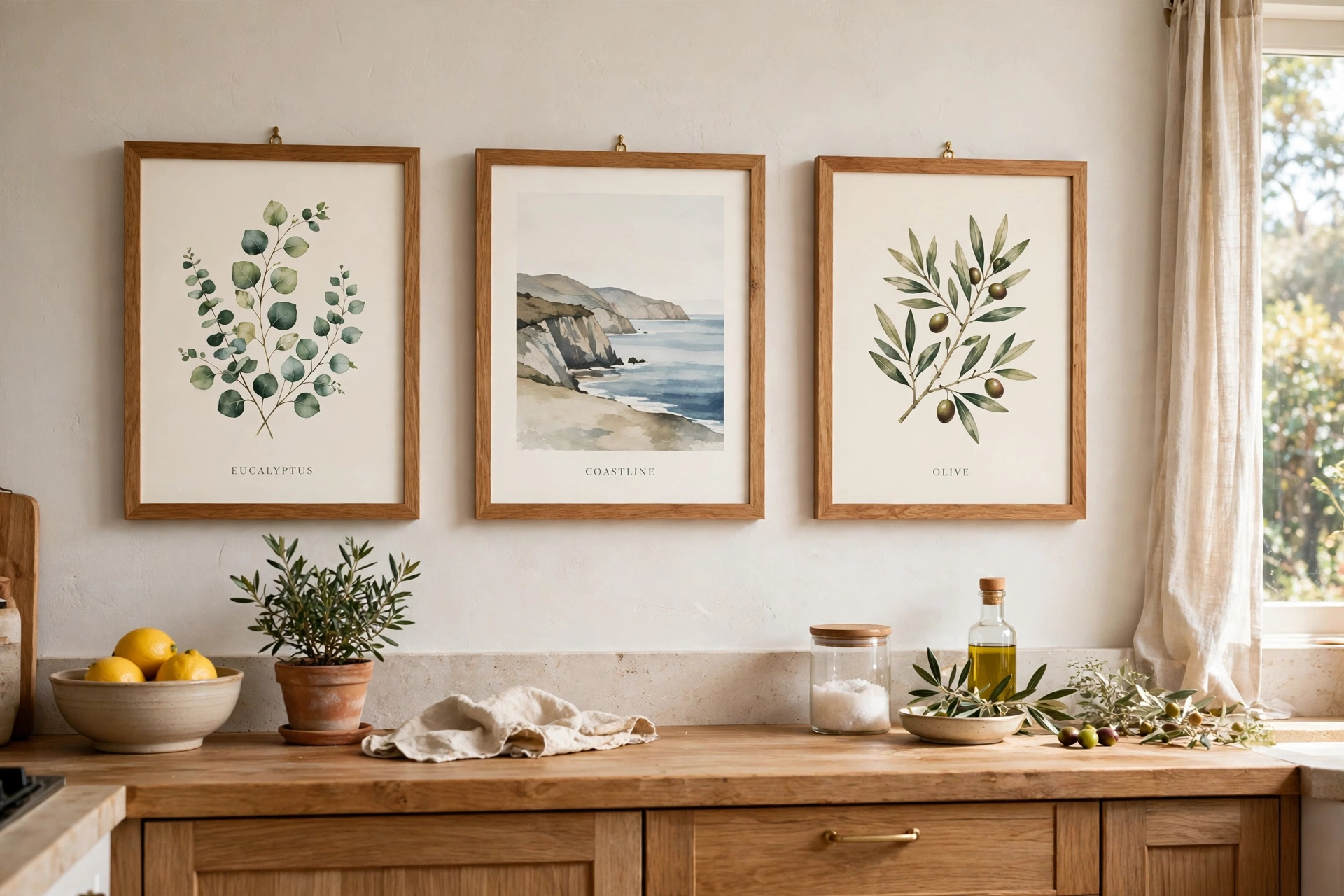
Hang Framed Art With Its Center at 57 Inches
Kitchen art hangs best with the center of the piece 57 inches from the floor, and the frame spanning about two-thirds the width of the counter, table, or cabinet run below it.
That 57 inch center line matches average eye level, and it keeps a grouping consistent across walls of different heights. A single 24 by 36 inch print fills the wall above a 36 to 54 inch counter run without crowding the cabinets. Pairs of 11 by 14 inch prints suit the narrow strip beside a window, and a lone 8 by 10 reads lost on any wall wider than 4 feet. Leave 4 to 6 inches between a countertop backsplash line and the bottom of a frame, if the art hangs over a work surface. Prices stay friendly in this category: print sets run $25 to $60, ready-made frames run $12 to $40, and a thrifted frame with a new mat often lands under $15 total.
Space Gallery Groupings 2 to 3 Inches Apart
A kitchen gallery wall reads as one piece when the frames sit 2 to 3 inches apart and share one frame color or one mat style.
Lay the whole arrangement on the floor first and photograph it before a single nail goes in. Six 8 by 10 inch frames with 2 inch gaps cover a block roughly 42 inches wide and 28 inches tall, which suits the wall above a 60 inch sideboard or hutch. Start with the largest piece slightly off center and build outward, keeping the outer edges on one shared line at the top or bottom. Paper templates taped to the wall let you live with the layout for a day, and that pause saves most kitchens from a crooked first attempt.
Choose Glass or Acrylic Fronts Near the Cooking Zone
Frames in the hot or steam zone need glass or acrylic glazing, because bare paper and canvas absorb grease vapor and curl at the edges.
Acrylic weighs about half as much as glass, so it is the safer front for a frame hanging over a sink where a falling piece lands in water and dishes. Metal frames and sealed, painted wood frames wipe clean with a damp cloth. Raw canvas and unsealed wood belong on dry walls, where a light dusting once a month keeps them fresh. One framed botanical print above a kettle station shows the difference fast: the glass front wipes clear in seconds, while an unglazed print in the same spot wrinkles by the end of one humid summer.

Style Open Shelves 10 to 12 Inches Deep, Loaded in Threes
Open shelves work as kitchen wall decor when they are 10 to 12 inches deep, spaced 12 to 18 inches apart vertically, and styled in groups of three objects per run.
Depth matters because a standard dinner plate measures 10.5 inches across, and a shelf under 10 inches deep leaves plates teetering at the edge. Two 36 inch pine shelves with brackets cost $30 to $80, and acacia or oak versions run $70 to $140 for the pair. Style each run with the same simple recipe: everyday dishes first, one plant or pitcher second, one small leaning print third. Daily-use dishes earn their place because constant handling keeps them dust free, while the top shelf holds the pretty pieces you grab twice a year. A loaded 48 inch shelf of 12 plates, 6 glasses, and a potted herb weighs close to 30 pounds. Stud mounting is not optional, if the loaded shelf passes 25 pounds.
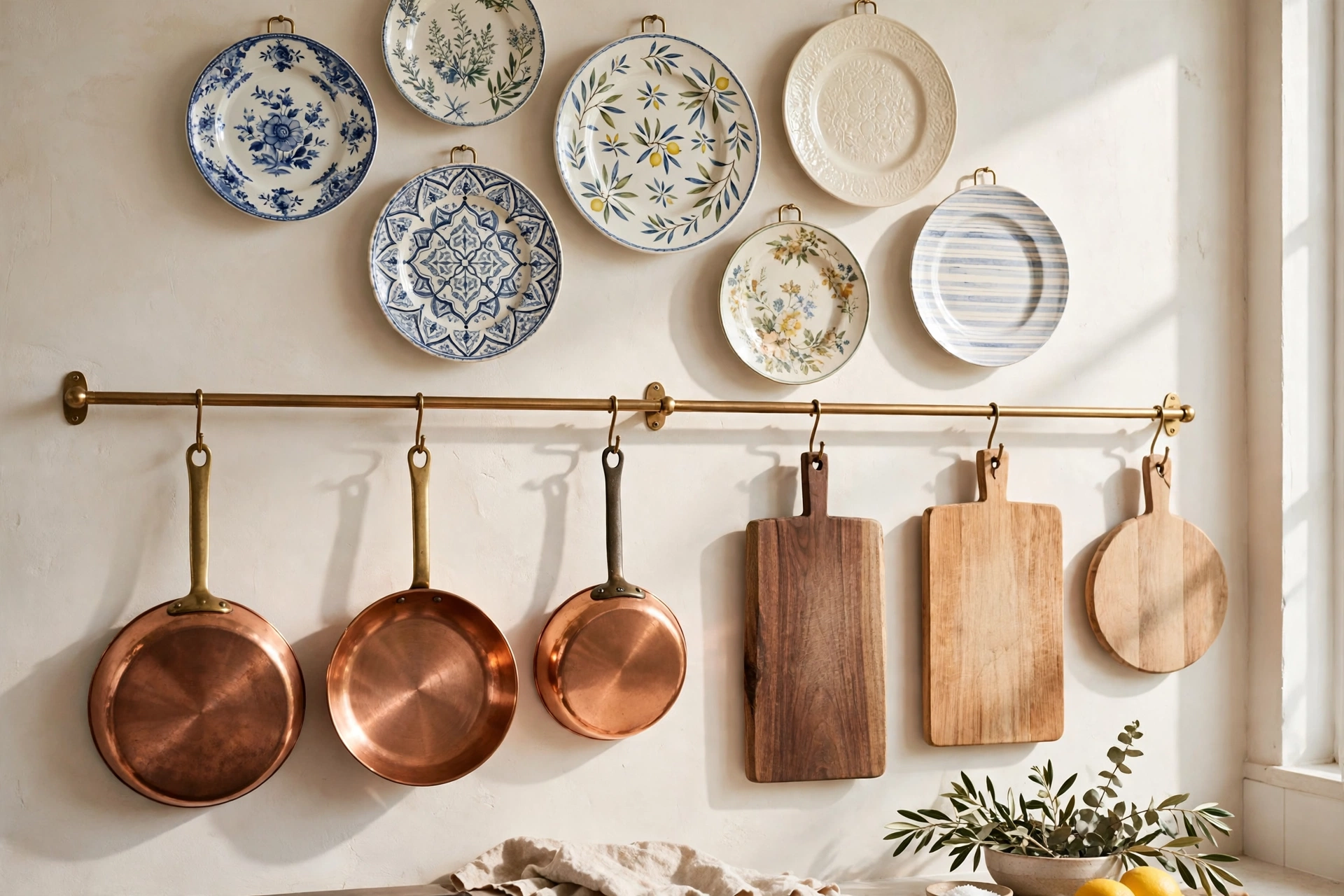
Hang the Plates, Pans, and Boards You Already Own
Plates, pans, and cutting boards become wall decor for nearly nothing, because disc hangers cost $1 to $3 each and a 24 to 36 inch pot rail costs $25 to $60.
This is the oldest form of kitchen wall decor, and it still beats buying art when the budget sits at zero. Wire hangers and adhesive disc hangers both come sized by plate diameter, so match the hanger to the plate and space the plates 2 to 3 inches apart. Choose wire hangers over adhesive discs, if a plate weighs more than 2 pounds. A wall rail with S-hooks turns five pans into a display, and cast iron pushes the math hard: one 12 inch skillet weighs about 8 pounds, so five pans land near 25 pounds on the rail. Screw that rail into studs, always. Cutting boards cluster well on plain screws, three boards in mixed shapes covering a 24 inch square for the price of the boards you already own.
Pick One Clock or Sign and Size It to the Wall
One clock or sign per kitchen is enough, and the right size is 12 inches across for a narrow wall strip and 18 to 24 inches for any wall wider than 5 feet.
Hang the center of the clock at 57 to 60 inches so it reads at a glance from the stove and the sink. A 12 inch clock disappears on an 8 foot wall, while a 24 inch clock above a 60 inch hutch balances the furniture below it. Wall clocks run $20 to $70 at most home stores, and wooden or metal signs run $15 to $50. Material decides placement here: metal and painted, sealed wood wipe clean anywhere, while raw MDF drinks steam and swells at the edges near a dishwasher. Keep word art to one short word or a family name, since a wall of slogans reads as clutter by the second sentence. One sign above the coffee station, for example, says more than four signs scattered across three walls.
Run Tile Up the Wall, or Fake It With Peel and Stick Panels
A full-height tile wall costs $12 to $25 per square foot installed, while peel-and-stick panels cost $3 to $6 per square foot and go up in one afternoon.
Tile is the most permanent kitchen wall decor in this guide, and ceramic or porcelain shrugs off range heat that ruins lesser materials. Running the backsplash tile from counter to ceiling behind the range is the defining kitchen wall move of 2026, and it turns the cooking zone into the focal point. Peel-and-stick panels suit renters and dry or steam zone walls, and most brands ask for distance from open gas flames, so read the heat rating on the box before you commit. The math stays small either way: the strip between counter and cabinets on an 8 foot run, at 18 inches tall, covers 12 square feet. That strip costs $36 to $72 in peel-and-stick, or $144 to $300 in installed tile, and the do-it-yourself (DIY) panel route needs nothing more than a level, a utility knife, and a free Saturday.
Fill the Leftover Strips: Above Cabinets, Over the Sink, Beside the Fridge
The strips above cabinets, over the sink, and beside the refrigerator take small, light, moisture-safe pieces: baskets, a mirror, and one narrow shelf carry those spots best.
These leftover strips are where kitchen wall decor usually goes wrong, because the spaces look empty and invite whatever is lying around. Most homes leave a gap of 12 to 18 inches above the cabinets, and woven baskets, stoneware crocks, and platters fill it without visual weight. Three baskets at $8 to $15 each dress a 6 foot run for under $45, though everything up there collects grease dust and needs a soapy wash twice a year. A windowless sink wall brightens fast with a 16 by 20 inch mirror at $25 to $45, and the mirror counts as steam zone safe. The 6 inch strip beside a refrigerator fits one shallow spice shelf or a magnetic knife strip, and both turn dead width into daily storage.
What a Finished Kitchen Wall Costs in 2026
A single styled kitchen wall costs $40 to $90 with thrifted art and plates you own, $150 to $300 with new shelves and prints, and $600 or more with tile.
The middle tier breaks down cleanly for a typical 8 foot wall: two shelves at $60, a pair of framed prints at $45, one clock at $35, and hangers plus anchors at $20, which totals $160. Spend on hardware before artwork, if the budget forces a choice between the two. Anchors, brackets, and hangers protect everything else you buy, and they are the cheapest line in the whole project. Stage the wall over two or three weekends instead of one shopping trip, and the layout gets a chance to settle before the drill comes out. Most people find the second arrangement, the one after a week of living with the first, is the one that stays.
FAQs
Can you hang a normal framed picture in a kitchen?
Yes, a framed picture works in most of the kitchen, and glass or acrylic glazing protects the print. Keep paper art 3 feet or more from the range, and wipe the glass monthly with a damp microfiber cloth.
How high should kitchen wall decor hang?
Centers sit at 57 inches from the floor for art and clocks. Frames above a counter stop 4 to 6 inches above the backsplash line, and shelf bottoms start 18 to 20 inches above the countertop.
Is peel and stick tile safe behind a stove?
No, most peel and stick panels are not rated for the wall directly behind a gas range, and heat softens the adhesive. Use real ceramic or porcelain tile there, and save peel and stick for low-heat walls.
How do you hang plates on a kitchen wall?
Pick wire or disc hangers sized to each plate diameter, and space plates 2 to 3 inches apart. Heaviest plates go at the bottom of the grouping, and every hanger screws into a stud or a rated anchor.
How much weight can open kitchen shelves hold?
A bracket pair screwed into studs holds 50 to 75 pounds, and the same brackets on drywall anchors hold about half that. Most loaded 48 inch shelves of plates and glasses weigh 25 to 35 pounds.
What can you put above kitchen cabinets?
Baskets, crocks, and platters suit the 12 to 18 inch gap above cabinets, and pale colors keep the strip from looking heavy. Everything up there collects grease dust, so pick pieces that survive a soapy wash.
How do you keep kitchen wall decor clean?
Wipe glass, metal, and tile monthly with a cloth dampened in warm water and one drop of dish soap. Grease film builds fastest within 3 feet of the range, so that zone needs a wipe every two weeks.
Conclusion
Start with one dry wall, hang the art you already own at the 57 inch line, and add shelves only where the studs carry the load. The zone rules, sizes, and prices in this guide repeat in every kitchen, from a 60 square foot rental galley to a farmhouse with a 10 foot island wall. Measure the wall before you buy a single frame, and let the zone map settle every argument about materials. A standard dinner plate measures 10.5 inches across, and a shelf 12 inches deep holds it with room to spare.