
Most kitchen decor ideas stop at the walls, as if art and shelves were the whole job. They are not. Kitchen decor is the full visible layer of the room: the palette on the cabinets, the objects on the counters, the textiles underfoot and at the window, the pendants over the island, and the centerpiece on the table. Layout and storage belong to other guides on this site. This one covers the layer you see, in the order a decorator works through it: palette first, counters second, then textiles, lighting, and centerpieces, with prices in United States dollars for 2026 and every size in inches and feet.
Start With a Color Palette That Ties the Room Together
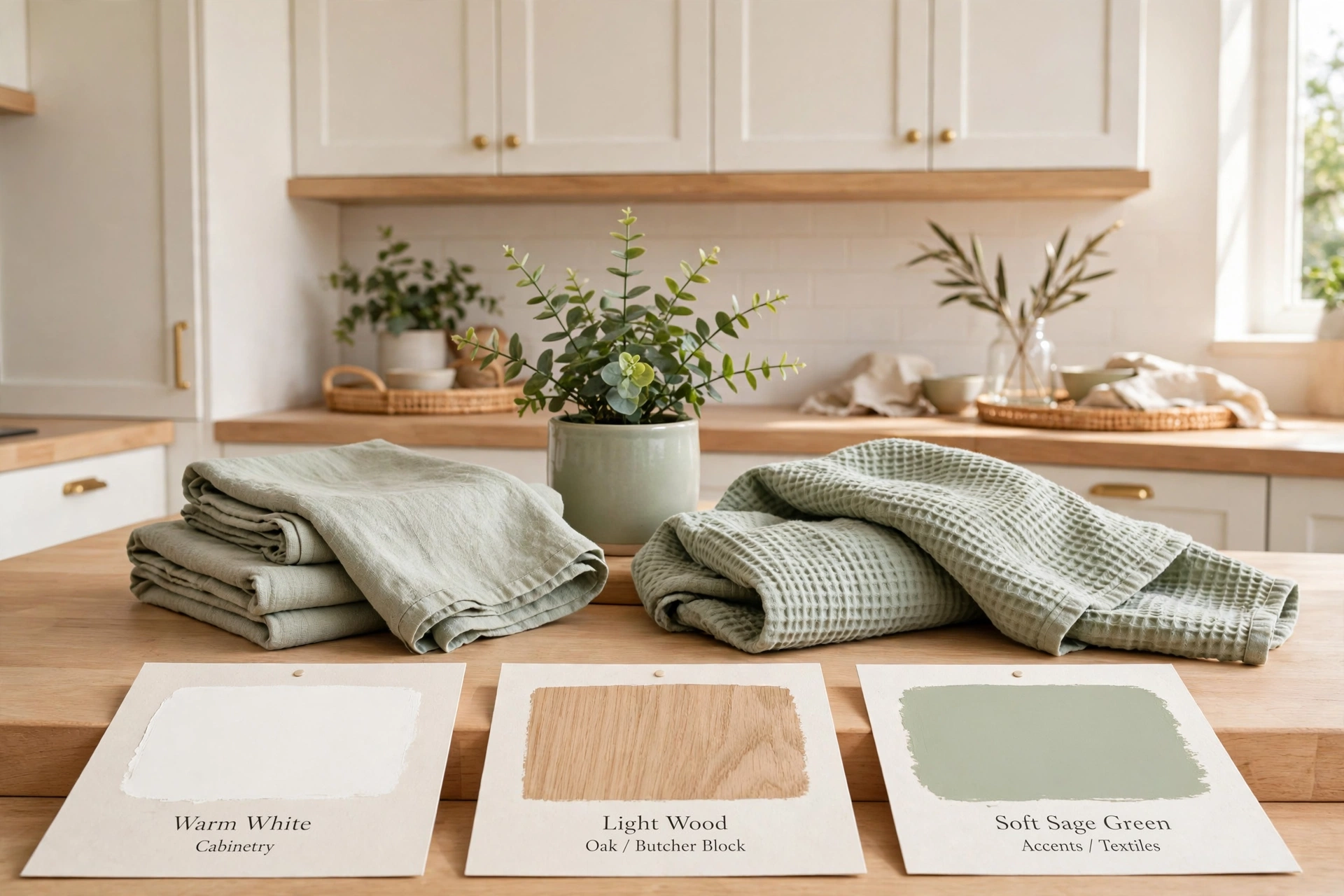
A working kitchen palette follows the 60-30-10 split: 60 percent a warm neutral, 30 percent one supporting color, and 10 percent a single accent.
Cabinets and walls usually carry the 60 percent, which is why warm whites like Benjamin Moore White Dove (OC-17) show up in so many finished rooms. The 30 percent layer comes from wood tones, the island paint, or a soft color such as Sherwin-Williams Sea Salt (SW 6204) on a lower cabinet run. Accent color takes the smallest share and lands on things you can swap in an afternoon: stool cushions, a kettle, a set of towels. One concrete test keeps the palette honest. Photograph the room, count the colors in the photo, and retire anything past the third color family, if the picture reads busy. Most kitchen decor ideas fail at exactly this point, because each purchase looked fine alone and the room ended up with six competing colors. Metal finishes count as colors too. Pick one main finish, brushed brass or matte black, and let it repeat on the faucet, the hardware, and the pendant frames so the eye reads one decision instead of three.
Hardware deserves one line of its own in the palette plan. Swapping 14 dated knobs for simple bar pulls at $4 to $9 each updates every cabinet door in the room for under $130. Finish the swap in the same metal as the faucet, and the cabinets read newer without a drop of paint. Paint itself stays optional at this stage. A gallon of cabinet paint runs $45 to $70 and covers a standard run of uppers and lowers, yet the palette still works through textiles and objects alone, if the existing cabinet color already sits inside the 60 percent neutral band.
Style the Countertops and Keep Two-Thirds of Them Clear
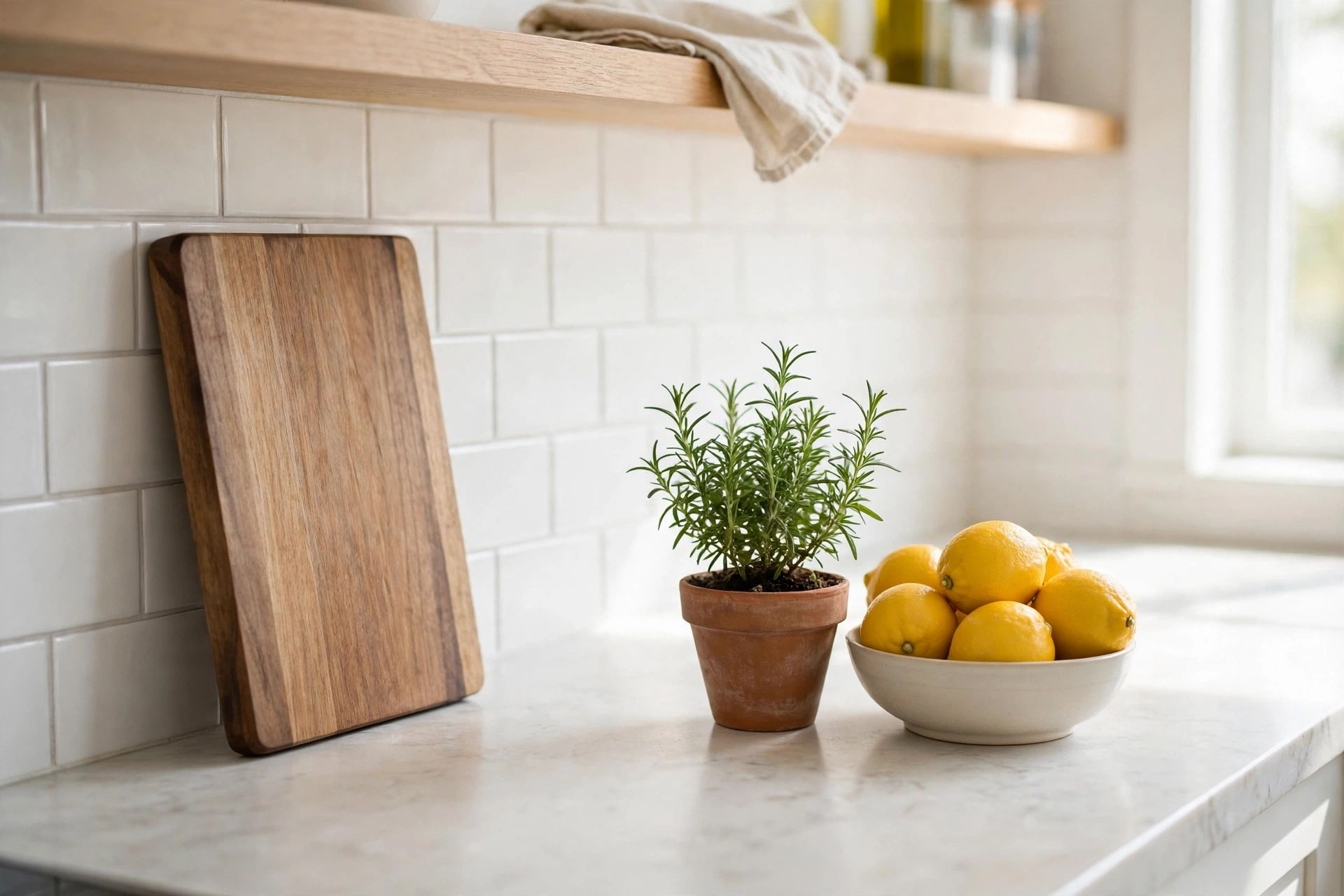
Countertop styling works when roughly two-thirds of the work surface stays empty and the remaining third holds grouped objects on trays, boards, and stands.
Bare counters read as unfinished, yet counters covered edge to edge read as storage, and neither look is decor. The middle ground is a few tight groupings with air between them. Start beside the range: a wooden board leaned against the backsplash, a crock of wooden spoons, and a small plant form one group of three. A tray does the same job near the sink, holding soap, a brush, and a folded towel in a footprint of about 12 by 18 inches. Coffee stations earn a fixed spot with a machine, a canister, and one mug tree on a 24 inch run of counter. Height matters as much as count. Tall items belong at the ends of a counter run, low items in the middle, so prep space stays open where hands actually work. Your counters will still look styled on a Tuesday night, if every object in a group gets used at least once a week. Pieces that fail that test move to a cabinet, and the group keeps its shape without them.
One more rule protects the look between deep cleans. Keep a clear landing zone of at least 15 inches beside the stove and the sink, completely empty. Hot pans and wet dishes land there daily, and a styled group in that spot gets scattered within a week. Groups survive at the quiet ends of the counter, near the wall oven or the refrigerator, where traffic passes but nothing lands.
Give Cabinet Tops and Open Shelves a Light Touch
Cabinet tops and open shelves need the lightest hand in the room: a few large pieces spaced wide, nothing small and fussy.
The gap above standard cabinets runs 12 to 18 inches in most homes, and big baskets, stoneware crocks, and platters fill it without visual noise. Three woven baskets at $10 to $18 each dress a 6 foot run for under $55. Open shelves follow the same logic in miniature. Everyday dishes first, one pitcher or plant second, and one leaning board or small print third, with about a third of each shelf left empty. Both spots collect grease dust faster than any other surface in the room. A twice-a-year soapy wash keeps them honest, and pieces that cannot survive that wash do not belong up there.
Layer Textiles: Runner Rugs, Cafe Curtains, and Towels
Textiles carry more color and pattern per dollar than any other decor category, and three pieces do most of the work: a runner, a window treatment, and towels that match the palette.
A runner softens the work aisle and protects the floor where you stand longest. Standard runners run 2 by 6 feet or 2.5 by 8 feet, sized to the gap between the island and the sink run. Washable cotton or low-pile wool blends survive kitchen traffic best, and a thin rug pad underneath stops the slide. Cafe curtains cover the lower half of the window, usually 24 to 36 inches long, giving privacy while daylight pours over the top. Full-length panels suit a dining window, yet they drag and spot near a sink, so the cafe length wins at the kitchen window itself. Towels are the cheapest palette tool in the room. A set of four linen or cotton towels in the accent color costs $15 to $30 and refreshes the whole scheme in minutes. These three textile moves sit behind most budget kitchen decor ideas for a reason: together they change what the room feels like for under $120, and every piece washes.
Bar stool cushions and a table runner in the dining zone extend the same palette past the work triangle. Match one textile exactly to the accent color and keep the rest neutral, so the pattern load stays low. A washable table runner at $18 to $35 carries the accent across the dining table without competing with the centerpiece.
Hang Pendant Lights as Decor, Not Just Task Lighting
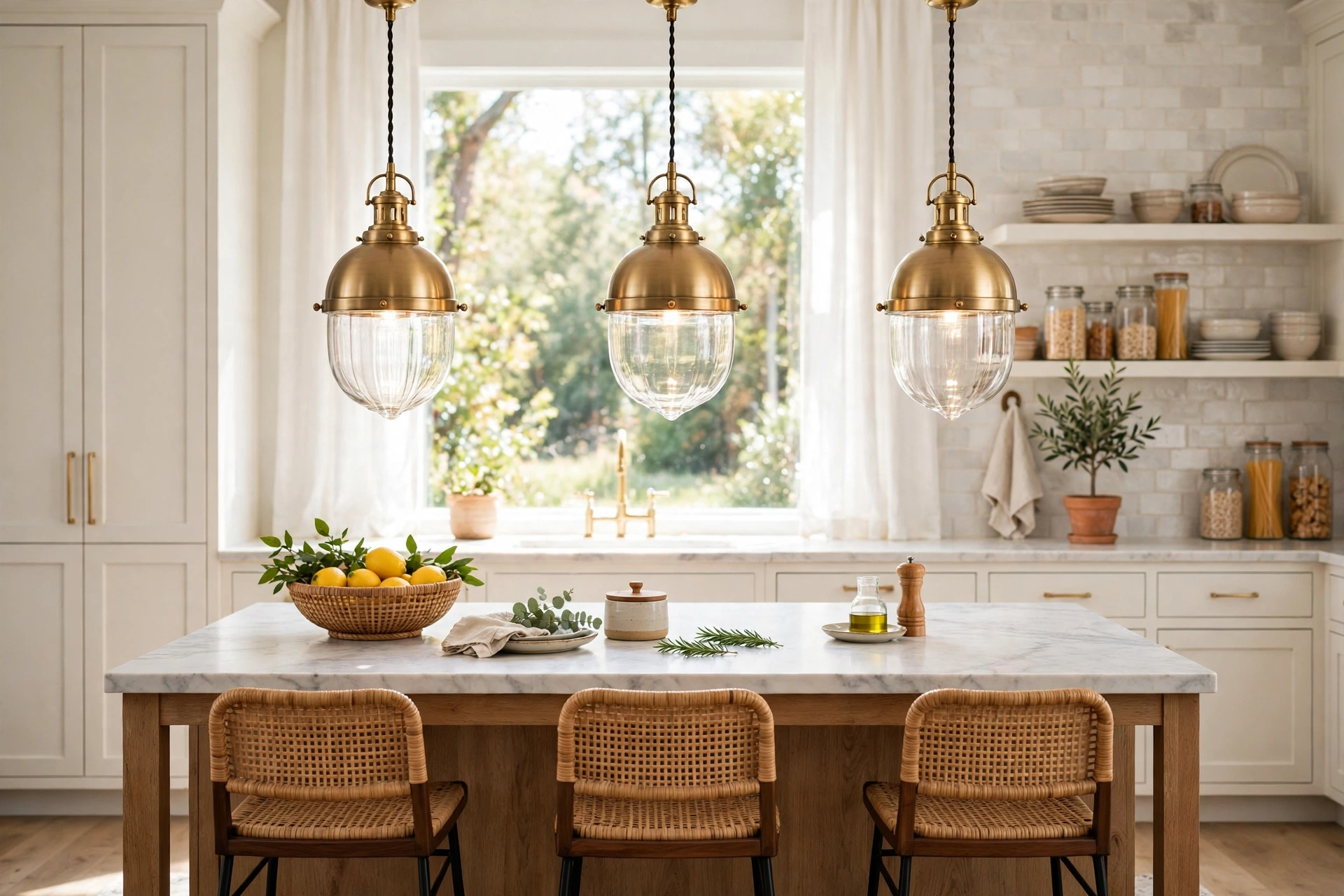
Pendants are the jewelry of the kitchen, and they decorate best when the bottom of each shade hangs 30 to 36 inches above the counter and the shade diameter runs about one-third the width of the island.
Size decides whether pendants read as decor or as hardware. One row of three 10 inch pendants suits a 6 foot island, while a single 24 inch statement pendant centers a 4 foot island or a small dining table. Spacing follows the same math: divide the island length by the number of pendants, then center each fixture in its share. Bulb choice finishes the look. Warm light-emitting diode (LED) bulbs at 2700 kelvin (K) flatter wood and skin, and exposed-filament styles belong inside clear glass shades only. Finish ties the pendants back to the palette. A matte black pendant over a black faucet reads as one system, and a brass pendant warms up white cabinets without adding a new color. Expect $60 to $180 per fixture at most home stores in 2026, with plug-in swag pendants starting near $35 for renters who cannot touch the wiring.
Dimmer switches protect the investment after dark. Pendants bright enough for chopping wash out a dinner at full power, and a $15 to $25 dimmer lets the same fixtures glow as decor during meals. Renters get a partial version of the trick with warmer bulbs and one pendant switched off, if the circuit allows separate control.
Build Island and Dining Table Centerpieces That Move
A good centerpiece stays under 12 inches tall or rises above 24 inches, sits on a tray or board, and clears the surface in under a minute when the room needs to work.
The middle heights are the trap, because a 16 inch arrangement blocks faces across a dining table and crowds a cook at the island. Low and wide wins on the island: a 16 to 20 inch tray holding a bowl of lemons, a small potted herb, and a stack of two cookbooks reads styled at breakfast and lifts away as one piece at dinner prep. Dining tables take the tall option instead. A single branch in a heavy vase, or three candlesticks at staggered heights, keeps sight lines open under the arrangement. Seasonal swaps keep kitchen decor feeling current without new purchases. Citrus in spring, tomatoes on the vine in August, and pinecones with a linen runner in December cover the year from one tray. The rule behind every version is movement: a centerpiece you cannot relocate with two hands will end up shoved into a corner, and a cornered centerpiece decorates nothing.
Height is not the only limit. Keep the footprint under one-quarter of the surface, so a 3 by 5 foot dining table holds a centerpiece no wider than about 15 inches across its tray. Anything broader turns serving dishes into obstacles, and the arrangement loses its place at the first family dinner.
Follow Stricter Rules in a Small Kitchen
Small kitchens decorate best with useful objects only: every visible piece should do a job, match the palette, or hang on a vertical surface.
Floor and counter space run out fast under 100 square feet, so the decor budget goes to things the room needs anyway. A beautiful utensil crock replaces a plain one at the same footprint. Matching canisters turn dry goods into a display along one 18 inch stretch of counter. Hooks and a rail lift mugs, pans, and towels onto the wall or the side of a cabinet, freeing drawers without adding a single object. Color discipline matters even more at this size. Two colors plus one metal finish is the ceiling, and a third color enters only through food or a plant. Small-space kitchen decor ideas succeed on editing, not addition: remove one item from every surface, then judge the room again before buying anything. Most owners find the removal alone finishes the job, and the money saved funds one good pendant or a better runner instead.
Glass-front canisters and a magnetic knife strip show the principle twice more: storage that looks deliberate. The strip frees a drawer, mounts in 10 minutes, and keeps 5 to 7 knives visible without a block eating 8 inches of counter. Guides to kitchen decor ideas for small spaces all land on this same short list, because a small room punishes every object that only sits there.
Walls Get One Short Note
Walls take the smallest share of whole-room decor: one clock, one sign, or one framed print per wall is plenty once the counters and textiles are styled.
This guide keeps walls brief on purpose, since sizes, zones, and hanging heights for kitchen walls have their own full article on this site. The short version: keep paper and canvas at least 3 feet from the range, hang centers near 57 inches, and let one wall stay bare so the styled surfaces stand out.
What Whole-Kitchen Decor Costs in 2026
A visible refresh of the whole kitchen costs $120 to $250 with textiles and counter styling alone, $400 to $800 once pendants and a centerpiece join in, and $1,200 or more when cabinet paint enters the plan.
The tiers below assume a standard 10 by 12 foot kitchen and United States retail prices for 2026. Spend in the order shown, since each tier assumes the one before it is done.
| Scope | What it covers | Typical cost | First buys |
|---|---|---|---|
| Textile refresh | Runner, cafe curtains, towel set, one tray grouping | $120-$250 | Runner rug, cafe curtain pair, 4 towels |
| Styled room | Textiles plus 2-3 pendants, centerpiece, canisters, crock | $400-$800 | Pendant set, island tray, matching canisters |
| Full decor layer | Styled room plus cabinet paint, hardware swap, stool cushions | $1,200-$2,500 | Cabinet paint, 12-20 pulls, pendant set |
Notice where the money lands at every tier: textiles and light first, objects second, surfaces last. Paint changes a room more than any single object, yet it also costs the most time, so it closes the plan instead of opening it. Renters stop at tier two and lose almost nothing, because every piece in the first two tiers leaves with them.
FAQs
What is the difference between kitchen decor and kitchen design?
Kitchen decor is the visible surface layer: color, textiles, objects, lighting fixtures, and centerpieces. Design covers layout, cabinet placement, and workflow. Decor changes in a weekend, while design usually needs a remodel.
How do I decorate a kitchen on a small budget?
Start with textiles, since a runner, cafe curtains, and a towel set together cost $120 or less. Group objects you already own on one tray next. Paint and lighting come last, once the palette is settled.
How much of the counter should stay empty?
About two-thirds of the work surface should stay clear for prep. Style the remaining third in tight groups on trays or boards. Counters read decorated, not cluttered, when every group has empty space around it.
What size pendants work over a kitchen island?
Choose shades about one-third the width of the island. Three 10 inch pendants suit a 6 foot island, and shades hang 30 to 36 inches above the counter. One 24 inch pendant centers a 4 foot island.
Can renters decorate a kitchen without permanent changes?
Yes. Textiles, tray groupings, matching canisters, and plug-in pendants change the room without touching walls or wiring. Every piece in a textile refresh is removable in under an hour on move-out day.
How many colors should a kitchen palette have?
Three color families plus one metal finish is the working limit. Neutral tones take about 60 percent, a supporting color 30 percent, and the accent 10 percent. A fourth color usually enters through food or plants only.
Do open shelves count as kitchen decor?
Yes, open shelves are decor and storage at once. Style them with everyday dishes, one plant or pitcher, and one leaning board per run. Leave about a third of each shelf empty so the display breathes.
Conclusion
Decorate in the order this guide follows and the room comes together without a remodel: palette, counters, textiles, pendants, centerpiece. Skip the order and the same money scatters across pieces that fight each other. Kitchen decor rewards restraint at every step, and editing costs nothing at all. A standard kitchen runner measures 2 by 6 feet, and two-thirds of every counter in a styled kitchen stays clear.