
What Boho Decor Actually Is
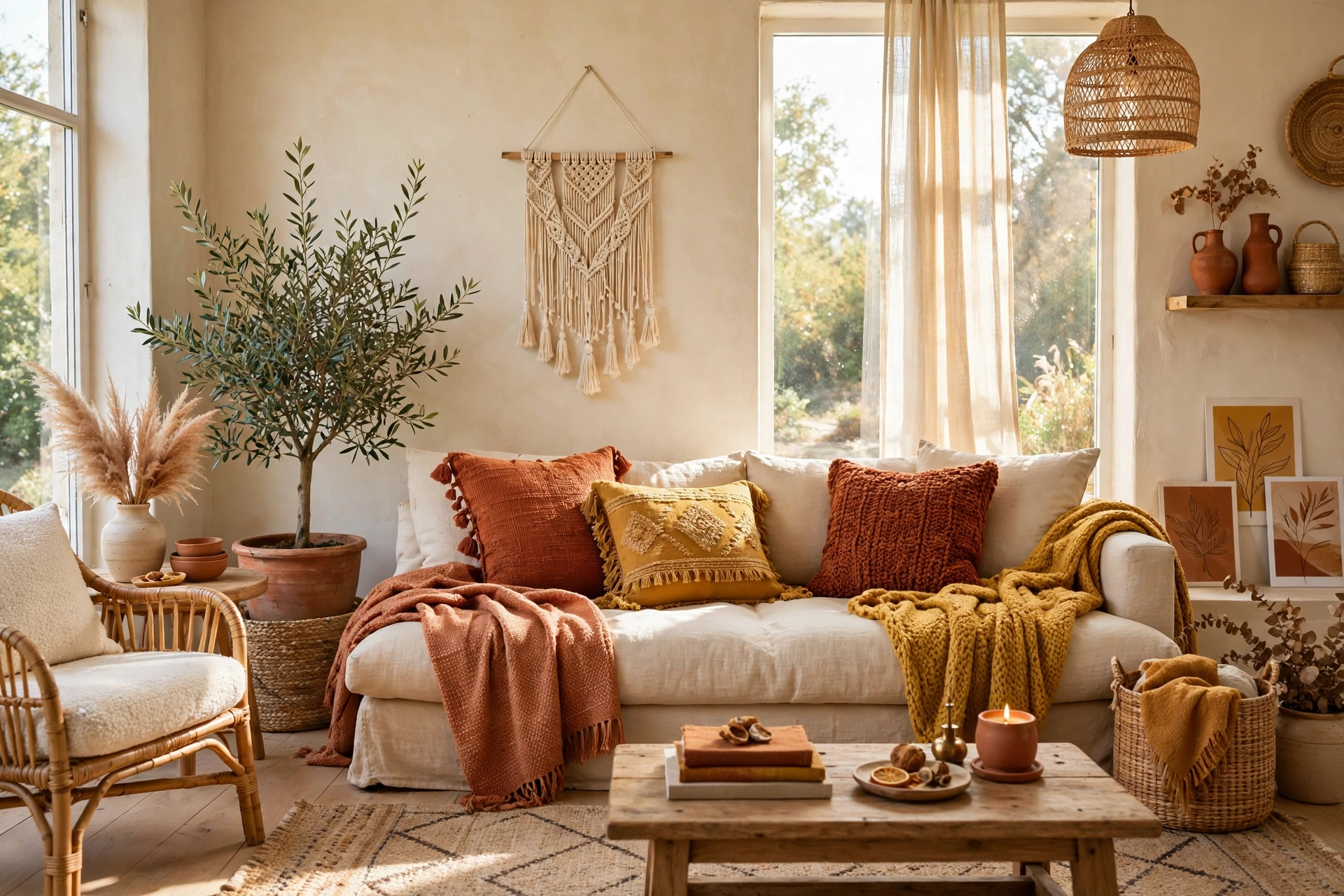
Boho decor is a relaxed, collected style built on natural materials, layered textiles, warm earthy color, and pieces gathered from different cultures and decades. The name comes from the bohemian artists of 19th century Paris, and the modern version took shape in the 1960s and 1970s through travel, craft revivals, and secondhand shopping. Today’s rooms split into two camps. Earthy boho leans on cream, clay, and cane, while rich boho loads up emerald, plum, and ochre. Both camps share the same skeleton, so you can switch camps by swapping textiles alone. Picture the standard setup: a linen sofa, a vintage kilim rug over plain jute, and a rattan chair that cost $40 at an estate sale. Nothing matches, yet everything speaks the same warm language. That collected feeling is the whole point, and it can’t be bought in a single boxed set. Sub-styles let you steer the mood without changing the recipe. Modern boho trims the pattern count and adds black metal or a cleaner sofa line, desert boho pulls the palette toward sand, rust, and cactus green, and boho farmhouse blends in white-painted wood and galvanized tin. Each variant still rests on the same base layers, so a room can drift from one to another as your taste changes.
Start With the Boho Color Palette
The working boho palette runs 60 percent warm neutrals, 30 percent earthy mid-tones, and 10 percent saturated jewel accents. Warm white walls carry the 60 percent share, and Benjamin Moore White Dove OC-17 or Sherwin-Williams Alabaster SW 7008 both sit in that soft, yellow-leaning family. Terracotta, clay, olive, rust, and ochre fill the middle band through rugs, cushions, and upholstery. Jewel tones then land in small, movable doses, like two emerald velvet pillows or one sapphire throw. Keeping the loud color on soft goods matters, since a $35 pillow is easier to swap than a painted wall. Renters can load the entire palette into textiles and art, if the lease keeps the walls white. One gallon of paint runs about $45 to $65 in 2026 and covers one accent wall in two coats, so a single clay-colored wall behind the sofa stays a cheap option for owners.
Choose Low, Natural Furniture
Boho furniture sits low, shows natural material like rattan, cane, teak, and mango wood, and mixes decades instead of matching. Seat height tells the story fast: boho sofas and lounge chairs sit 15 to 18 inches high, against 19 to 20 inches for formal furniture, and that drop makes a room feel settled rather than upright. A peacock chair, a daybed with bolster pillows, or a pair of 24 inch floor cushions all deliver the low, lounging profile. Vintage stock should come first in the budget, because a thrifted teak credenza often costs $75 to $200 while a similar new piece runs $600 or more. Mixing eras works when the wood tones stay within the same warm family, even if the pieces span forty years. Glossy lacquer and chrome break the mood, so matte and woven finishes win almost every time. Storage follows the same logic: woven baskets and ladder shelves keep blankets and books visible but contained.

Layer Textiles With a System
Layer textiles in a fixed order: a natural-fiber base rug first, a smaller patterned rug on top, then pillows in odd numbers and mixed pattern scales. The base rug should be jute, sisal, or seagrass in a size that anchors the seating, and an 8 by 10 foot jute rug costs $100 to $300 at most large home stores. A 5 by 8 foot vintage kilim or Persian style rug layered over it brings the pattern, sized at roughly two-thirds of the base so the border of jute still shows. Pillows follow a count you can copy: two 22 inch squares, two 18 inch squares, and one lumbar on a standard sofa, five in total. Pattern scale keeps the mix calm, with one large print, one medium stripe or geometric, and one small ditsy print sharing at least one color. Throws add the last layer, and a chunky knit or fringed cotton throw draped over the sofa arm costs $20 to $45. Every textile in the room should pass one test: it is either natural fiber or it earns its place with color. Window coverings count as a textile layer too. Sheer linen curtains that pool an inch on the floor soften daylight and cost $25 to $40 a pair, while heavy blackout drapes fight the airy mood the style depends on. Upholstery follows the same test, so a washable cotton slipcover in warm white can turn a tired gray sofa boho for about $60.
Light the Room Warm
Boho lighting runs warm at 2700K and comes from at least three sources at different heights in every main room. The K stands for Kelvin, the scale that measures light color, and 2700K matches the glow of late afternoon sun. Modern light-emitting diode (LED) bulbs hit that warmth for about $3 each, so swapping six overhead bulbs costs under $20. Height layering does the rest of the work: a woven rattan or seagrass pendant overhead, a table lamp at seat height, and candles or a low lantern near the floor. Pendants over a dining table hang 30 to 36 inches above the tabletop, low enough to pool light on the food without blocking faces. Harsh white 4000K bulbs flatten every earthy tone in the room, which is why so many boho spaces feel right at night and wrong at noon under builder-grade lighting. String lights can join the mix, if they play a supporting role behind real furniture instead of carrying the room alone. A plug-in dimmer switch runs $15 to $25 and softens any lamp you already own.

Add Plants That Match Your Light
A medium living room needs five to seven plants, each matched to the light at its spot rather than bought as a matching set. Bright south or west windows suit a fiddle leaf fig or bird of paradise, both of which grow 4 to 6 feet tall indoors and anchor an empty corner. Medium light a few feet from a window handles a monstera or rubber plant without complaint. North-facing rooms and hallway corners call for the tolerant trio: pothos, snake plant, and ZZ plant, which hold their leaves in light too dim for most other species. Trailing pothos on a high shelf softens hard lines and needs water only every one to two weeks. Planters follow the material rule, so terracotta pots and seagrass baskets with plastic liners replace glossy plastic every time. Grouping plants in threes at different heights, one tall, one medium, one trailing, reads as a deliberate garden instead of a random collection. Seven plants is also the practical ceiling for most people, since watering day stays under ten minutes at that count. Cost stays low at the nursery end of the hobby: 6 inch pots of pothos and snake plants run $12 to $20 each, and a friend’s pothos cutting roots in a jar of water for free. Drainage decides whether those cheap plants survive, so every pot needs a hole or a gravel layer and a saucer under it.
Boho Decor in the Dining Room, Entryway, and Kitchen
Boho decor travels through a home on repeated material, so rattan, jute, and warm wood should reappear in the dining room, entryway, and kitchen. Dining rooms take the look through one woven pendant over the table, a jute runner underfoot, and wooden chairs that do not need to match each other. A linen table runner and a bowl of oranges or dried pampas grass handle the centerpiece job without a formal arrangement. Entryways work harder in a small footprint: a wooden bench with one patterned cushion, a woven basket for shoes, and a 2 by 3 foot flatweave rug by the door. Kitchens join in through open shelves holding handmade ceramics, woven placemats stacked in a basket, and terracotta pots of basil and rosemary on the sill. Repeating the same three materials in every room is what makes a whole home read boho rather than one themed corner. Guests feel the thread even when they can’t name it.
What Boho Decor Costs
A boho living room costs about $150 to refresh with textiles alone, about $900 for a mid-level redo, and $2,500 or more when furniture gets replaced. The table below breaks the three tiers down by what the money actually buys.
| Budget tier | Total cost | What it buys | Best for |
|---|---|---|---|
| Textile refresh | $150 to $300 | Jute rug, 5 pillow covers, 1 throw, 3 plants | Renters and first tries |
| Mid-level redo | $800 to $1,200 | Rug pair, used rattan chair, pendant light, plants, ceramics | Owners keeping their sofa |
| Full room | $2,500 to $4,000 | Sofa or daybed, vintage credenza, rug pair, lighting, full textiles | Empty rooms and movers |
Secondhand buying changes the math at every tier, since vintage furniture usually sells for a third to half of its new price. A sample $900 mid-level split looks like this: $180 for the layered rug pair, $120 for pillows and a throw, $250 for a used rattan chair and side table, $150 for plants and planters, $80 for a woven pendant, and $120 for ceramics and objects. Spend in the layering order, rugs first and small objects last, if money runs short halfway through the plan. Small objects are the easiest layer to add later, one flea market trip at a time. Dining rooms follow the same math at a smaller scale: a woven pendant at $70, a jute runner at $60, and thrifted wooden chairs at $25 each can redo a four-person dining set for under $300.
Mistakes That Turn Boho Into Clutter
Boho turns into clutter when every surface is full, the patterns share no color, or everything arrives new from one store in one week. The fix starts with empty space: leave roughly a third of every shelf bare, and group objects in threes with varied heights instead of lining them up. Ten small objects read as noise, while one large woven basket reads as a statement, so scale up and count down. Matching decor sets are the second trap, because a room assembled from one retailer’s boho collection looks staged no matter how textured the pieces are. Time is the third ingredient people skip. Real boho rooms gather over months, with travel finds, gifts, and thrift scores landing one at a time, and that slow pace is exactly what makes the style hard to fake. Edit once a season, pulling out anything that earns neither use nor affection.
FAQs
What is the difference between boho and boho chic?
Boho chic keeps the same natural materials and layered textiles but edits harder: fewer patterns, a tighter palette of three or four tones, and more breathing room around each piece.
Is boho decor still in style in 2026?
Yes, boho decor remains a steady seller in 2026 because it runs on vintage stock and natural fiber basics rather than trend pieces, so its core items never tie to one season.
How many patterns can you mix in one room?
Three patterns are the safe working number for one room: one large print, one medium stripe or geometric, and one small print, all sharing at least one color from the palette.
Can boho decor work in a small apartment?
A small apartment takes boho well when the palette stays earthy and light, the rug stays single instead of layered, and floor cushions replace a second chair to keep the floor plan open.
What wall colors suit a boho home?
Warm whites like Benjamin Moore White Dove and soft clay tones suit boho walls best, since they flatter terracotta, olive, and jewel accents without competing with patterned textiles for attention.
How do you do boho decor on a tight budget?
Start with the textile layer only: a jute rug, thrifted pillow covers, one throw, and propagated plant cuttings from friends. That package lands near $150 and changes the room more than any single furniture piece.
Can you mix boho with modern furniture?
Modern furniture mixes in cleanly when its lines stay simple and its colors stay warm. A plain white modern sofa under kilim pillows and a jute rug reads boho within one afternoon of styling.
Conclusion
Boho decor rewards patience more than money, since the look depends on gathered pieces, natural fiber, and warm light rather than any single purchase. Start with the palette, layer textiles in order, and let plants and vintage finds arrive over time. A renter with $150 and one free weekend can finish the textile layer of a living room before Sunday night. The style’s raw materials have stayed cheap and available for decades, and an 8 by 10 foot jute rug still costs between $100 and $300 at most large home stores in 2026.