

Start With Paint, the Cheapest Wall in the Room
Paint is the cheapest full-wall upgrade in a bathroom, and a satin or semi-gloss finish with a mold-resistant formula is the right choice for steamy rooms. A gallon costs $35 to $60 in 2026 and covers 350 to 400 square feet, so one gallon handles the walls of most bathrooms with paint left over. Humidity beads on satin instead, and a damp cloth wipes it clean.
Color does work that no frame can do. Deep green walls behind a white pedestal sink make standard brass hardware look twice as expensive. Pick the wall color before you pick a single frame, because every print and mirror has to sit against it. Treat paint as the base layer of bathroom wall decor, and everything you hang later gets easier to choose.
Pick a Sheen for Each Wall
Semi-gloss belongs on the walls that catch spray, and satin belongs everywhere else. The wall behind the sink and the wall beside the tub take daily splashes, so they get the harder, shinier finish. Drier walls in the same room can wear satin, which hides small drywall flaws better under side light. Powder rooms without a shower can even use a bathroom-specific matte paint, such as Benjamin Moore Aura Bath and Spa, because steam never builds up in them. Buy the mold-resistant version of any paint you choose, if your bathroom has no window.
Match Every Material to Its Moisture Zone
Your bathroom walls split into a wet zone inside the shower’s splash range and a dry zone everywhere else, and each zone has its own safe materials. Tile, stone, and polyvinyl chloride (PVC) panels shrug off direct water in the wet zone. Sealed prints, vinyl wallpaper, and painted wood belong in the dry zone, where steam is the only enemy.
Steam alone pushes bathroom humidity past 70 percent during a long shower. That moisture drifts across the whole room, so even dry-zone art needs a sealed frame or a wipeable surface. Paper absorbs it, swells, and ripples behind the glass. Distance buys safety: art hung at least 24 inches away from the shower spray pattern usually stays in dry-zone conditions.
Ventilation decides how long any of this lasts. Fans are rated in cubic feet per minute (CFM), and a 50 square foot bathroom needs at least a 50 CFM fan to clear steam properly. Run the fan during every shower and for 20 to 30 minutes after you’ve stepped out, because lingering steam is what feeds mildew on grout and curls print corners.
Use this table to match a material to your wall before you spend anything:
| Material | Best zone | Steam tolerance | Typical cost | Renter friendly |
|---|---|---|---|---|
| Sealed framed print | Dry | High, with fan use | $15-$60 | Yes |
| Metal print | Dry or damp | Very high | $30-$90 | Yes |
| Gallery wrapped canvas | Dry | Medium to high | $25-$80 | Yes |
| Ceramic or porcelain tile | Wet | Total | $3-$12 per square foot | No |
| Vinyl wallpaper | Dry or damp | High | $1.50-$4 per square foot | No |
| Peel and stick tile | Dry | Low to medium | $2-$5 per square foot | Yes |
| Mold-resistant paint (satin) | Both | High | $35-$60 per gallon | With permission |
| PVC wall panel | Wet | Total | $2-$6 per square foot | No |
Hang Art at Eye Level, Not Guess Level
The center of a framed print belongs 57 inches from the floor, the same eye level museums use for gallery walls. A center at 57 inches puts the middle of the frame in front of a standing adult’s eyes. Groups of frames count as one unit, so measure to the center of the whole grouping instead of the center of each piece.
Art Above the Toilet
Leave 6 to 10 inches between the top of the toilet tank and the bottom edge of the frame. One 16 by 20 inch print or a vertical pair of 8 by 10 prints fits the typical 24 to 30 inch wall width above a toilet. Center the piece on the toilet itself, not on the wall, because your eye reads the tank as the anchor for everything above it.
Art Beside and Across From the Mirror
A print hung on the wall facing the mirror does double duty, because the glass reflects it all day. Flanking prints work too, if the vanity wall gives you at least 12 inches of free space on each side of the mirror. Keep pairs identical in size and frame finish, hung with their centers level with the mirror’s center. Mismatched pairs beside a mirror read as clutter, while matched pairs read as design.

Build a Gallery Wall That Steam Cannot Ruin
A bathroom gallery wall lasts when every frame is sealed and every piece inside is a replaceable print, never an original work on paper. Moisture creeps in through the back of an unsealed frame first, so tape the back edges shut or buy frames sold as sealed. Acrylic glazing beats real glass here: it weighs less, it sweats less in temperature swings, and it will not shatter over a tub.
Metal prints and gallery wrapped canvas skip the frame problem entirely, since both wipe clean with a damp cloth. Lay the arrangement on the floor first and photograph it, then transfer the layout to the wall with paper templates and tape, and you’ll spot spacing mistakes before any hole exists. Five black frames in mixed 5 by 7, 8 by 10, and 11 by 14 inch sizes fill a 48 inch wall above a standard tub for about $45 in thrift store frames. Space the pieces 2 to 3 inches apart so the group breathes but still reads as one piece of bathroom wall decor.

Let the Mirror Do Decorative Work
A mirror sized close to the vanity width reflects more light and more of the room than any framed print can.
Size it by the vanity: a mirror should run 2 to 4 inches narrower than the vanity top, so a 36 inch vanity takes a 32 to 34 inch mirror. Hang it with the center about 60 inches from the floor and the bottom edge 5 to 6 inches above the backsplash. Round mirrors from 24 to 36 inches across soften a room full of hard tile corners.
Sconces flanking the mirror need damp or wet location ratings, and any new wiring near a sink needs ground fault circuit interrupter (GFCI) protection. Mount sconce centers 60 to 66 inches high, level with your eyes, so light lands on your face instead of the ceiling. A framed mirror in sealed wood or metal also counts as bathroom wall decor, so match its finish to the faucet or to your art frames instead of fighting both.
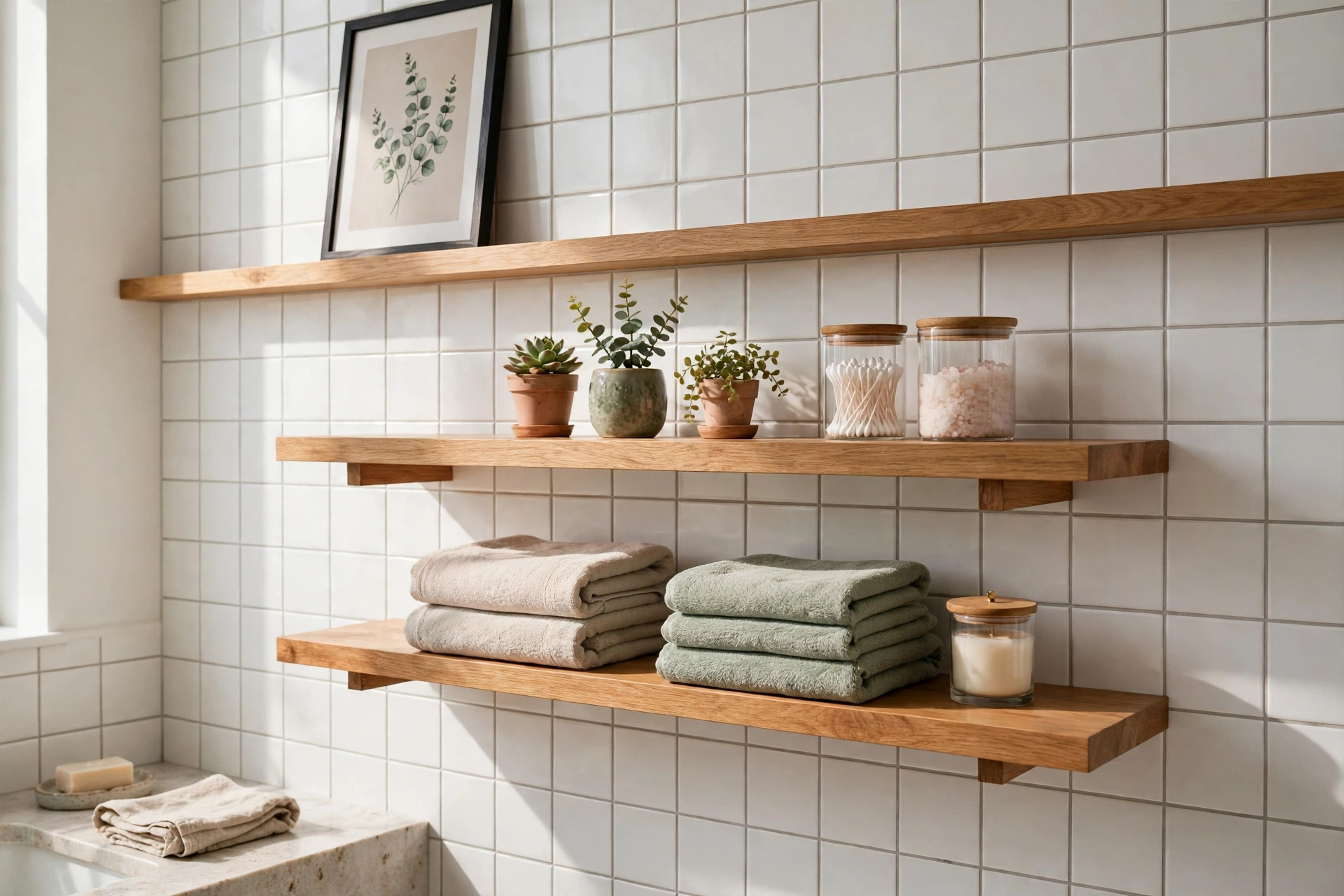
Add Floating Shelves and Picture Ledges
Two floating shelves above the toilet turn a blank wall into real storage without touching the floor plan.
Keep above-toilet shelves shallow: 6 inches deep is enough for folded towels, cotton jars, and a small plant, and nobody bumps a head on 6 inches. Hang the lowest shelf at least 24 inches above the tank lid so the lid lifts off freely and heads stay clear.
Weight limits decide what a shelf can carry. Screws driven into studs hold about 50 pounds per shelf, while toggle anchors in plain drywall hold 25 to 50 pounds depending on anchor size. The small plastic anchors packed free with many shelf kits hold under 25 pounds and belong in the trash, not in a bathroom wall. Style each shelf in threes: a stack of towels, one lidded jar, one plant or mini print. Picture ledges, usually 3.5 inches deep, suit the wall beside the mirror, where you can swap prints with the seasons and never drill a new hole.
Use Tile as Wall Decor That Never Comes Down
Tile never peels, never warps, and never has to come down for moisture, so its pattern does the decorating on any wall it covers. That permanence earns tile a place in every bathroom wall decor plan, because a $3 subway tile looks custom or basic depending only on the layout you choose.
Brick layout reads classic, a vertical stack reads modern, and herringbone turns a plain 3 by 6 inch tile into a focal wall behind the vanity. Half-height tile to 48 inches, capped with a chair rail or a shallow ledge, protects the splash zone and leaves the upper wall free for paint and art.
Shower and tub walls need cement backer board and a waterproof membrane behind the tile, not drywall, and that hidden layer is where tile jobs succeed or fail. Peel and stick tile belongs on dry walls only, since steam works behind the adhesive and drops panels within a year, if the wall sits inside the spray zone. Professional installation runs $10 to $25 per square foot in 2026, so a single accent wall behind a vanity is where most budgets should start.
Cover Big Walls With Wallpaper and Panels
Vinyl wallpaper is the safe wallpaper for a full bathroom, and peel and stick paper belongs in powder rooms and low-steam baths. True paper wallpaper absorbs steam at its seams, lifts, and peels within a year or two in a shower bathroom.
Beadboard and wainscoting protect the lower wall, the part that takes towel drips and mop splashes. Run panels 32 to 48 inches high, cap them with a rail, and paint them semi-gloss for wipeable armor. Choose PVC beadboard over wood or fiberboard in a wet room, because it cannot swell or rot. A bold floral vinyl on all four walls of a 5 by 8 foot powder room takes about two rolls, roughly $80 to $150, and needs no other decor at all.
Mount Storage Directly on the Wall
Wall-mounted storage keeps counters clear, and three pieces cover most bathrooms: an over-toilet cabinet, a recessed medicine cabinet, and a hook rail. Cabinets use the wall’s depth instead of the room’s floor space, which is the trade a small bathroom always wins.
An over-toilet cabinet 24 to 30 inches wide and 6 to 8 inches deep holds spare rolls, cleaners, and the bottles that crowd a sink edge. A recessed medicine cabinet hides between studs, which usually stand 14.5 inches apart inside the wall, so its box adds storage with zero projection into the room. Hook rails beat towel bars for families: four hooks on 5 to 6 inch spacing dry four towels in the wall space where one bar serves two. Mount every cabinet and loaded rail into studs, because a full cabinet can pass 30 pounds and anchors alone creep loose under daily door swings.
Small Bathrooms and Rentals Need No-Drill Walls
Adhesive strips and hooks rated for humid rooms let renters hang real decor, as long as every piece stays under the strip’s weight limit. Large picture-hanging strips hold up to 16 pounds, and bathroom-rated adhesive hooks hold 3 to 7 pounds each.
Metal prints suit this method best, since they’re light, sealed, and flat against the wall. Hang one larger piece instead of five small ones in a 5 by 5 foot bath, because a single 20 by 30 inch print calms a small wall while a cluster crowds it. Aim the decor at the wall facing the mirror, and the reflection doubles it for free. Lean a framed print on a shallow adhesive ledge above the sink, if your lease bans strips on tile. When you move out, a slow pull on the strip’s release tab breaks the bond with no hole and no paint damage, which is the whole point.
FAQs
What kind of art is safe in a steamy bathroom?
Sealed framed prints, metal prints, and gallery wrapped canvas handle steam best. Acrylic glazing beats glass in this room, and frame backs taped shut block the moisture that curls unprotected paper.
How high should art hang above a toilet?
Center the piece near 57 inches from the floor, with 6 to 10 inches between the tank lid and the frame’s bottom edge. Align it with the toilet rather than the wall.
Can peel and stick tile go inside a shower?
No. Steam and direct spray work behind the adhesive, and panels loosen or drop within about a year. Save peel and stick tile for dry walls outside the spray zone.
What paint finish works best on bathroom walls?
Satin works on most walls, and semi-gloss works better behind sinks and beside tubs. Both finishes wipe clean, and mold-resistant formulas slow mildew growth in rooms without windows.
How wide should a mirror be over a 36 inch vanity?
Pick a mirror 32 to 34 inches wide, which leaves 1 to 2 inches of wall showing on each side. Hang it with the center near 60 inches from the floor.
How much weight can a floating bathroom shelf hold?
A shelf screwed into studs holds about 50 pounds. Toggle anchors in drywall hold 25 to 50 pounds, while small plastic anchors hold under 25 pounds and should be replaced.
Will wallpaper peel in a bathroom with a shower?
Paper wallpaper usually peels at the seams within a year or two. Vinyl and vinyl-coated wallpaper hold up for years, especially with the exhaust fan running during and after showers.
Conclusion
Start with the wall you see from the doorway, and give that wall one treatment done properly before you touch the others. A standard 5 by 8 foot bathroom holds roughly 200 square feet of wall surface once the tub and vanity walls are counted.