

Bedroom decor is the movable layer of the room, meaning the textiles on the bed, the art on the walls, the lamps beside the bed, and the small objects on the dresser. Furniture stays in place for years. This layer changes in one afternoon. Paint pairings belong to a separate decision, and furniture layout belongs to another guide, so these rules don’t wander into either topic. Sizes, counts, temperatures, and prices below come from the measurements decorators repeat across projects: two-thirds art width, 57 inch hanging height, 2700K bulbs, and three items per nightstand.
What Bedroom Decor Includes
Bedroom decor includes every removable styling item in the room: bedding textiles, curtains, rugs, wall art, mirrors, lighting accents, plants, and small surface objects.
A duvet cover counts as decor, and the bed frame under the duvet cover doesn’t. That split matters at purchase time. Shoppers who sort a wish list by this definition stop buying furniture prices for styling problems. One $45 set of washed cotton pillow shams changes how a bed reads from the doorway more than a $400 headboard swap does in a dim room. Rules govern the layer better than taste does. Most bedroom decor regrets trace back to objects bought before anyone set a size, a count, or a budget for the room.
Wall Decor Above the Bed and on Bare Walls
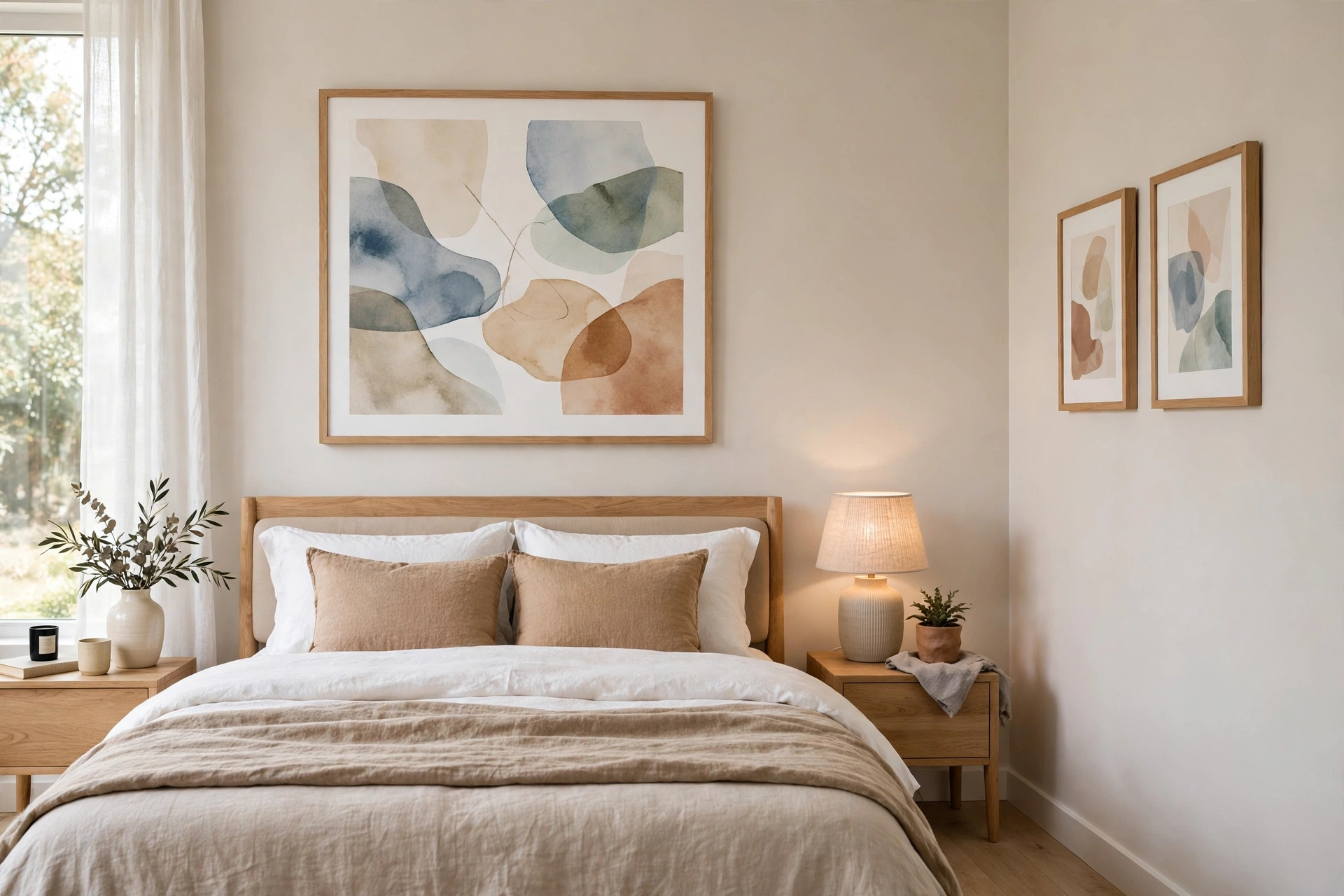
Wall decor holds one scale rule in a bedroom: art above the bed spans about two-thirds of the bed width, and the center of the piece hangs 57 to 60 inches from the floor.
Art Size and Hanging Height
A queen bed measures 60 inches wide, so the art above a queen bed needs roughly 40 inches of width. Retail frames sell in standard sizes, and a 40 x 30 inch horizontal print or a pair of 20 x 30 inch prints both hit that target. Leave 6 to 8 inches between the bottom of the frame and the top of the headboard. Crowding the headboard makes the art read as part of the furniture. Groups of three to five smaller frames work under the same math, provided the outer edges of the group still total two-thirds of the bed width. Weight decides the hanging method. A framed 40 x 30 inch print usually weighs 6 to 10 pounds (2.7 to 4.5 kilograms), and two large adhesive strip pairs rated at 8 pounds each hold that print safely if a lease bans nails.
Mirrors, Frames, and Small Wall Accents
Mirrors earn wall space by moving daylight, and a round mirror of 24 to 32 inches across from a window spreads morning light into dark corners. Renters get the same bedroom decor effect from a leaning floor mirror near 60 inches tall, since a leaning mirror needs no holes at all. Small accents follow a grouping rule rather than a solo rule. Three small frames in a row read as one deliberate piece, while one small frame alone reads as an afterthought. Wall space beside the bed suits a pair of matching prints hung over each nightstand, centered on the nightstand width rather than on the wall.
Textiles: Bedding, Curtains, and Rugs
Textiles carry the largest share of bedroom styling: a layered bed, full-length curtains, and a correctly sized rug set the texture of the room before any accessory arrives.
Bedding Layers That Look Styled
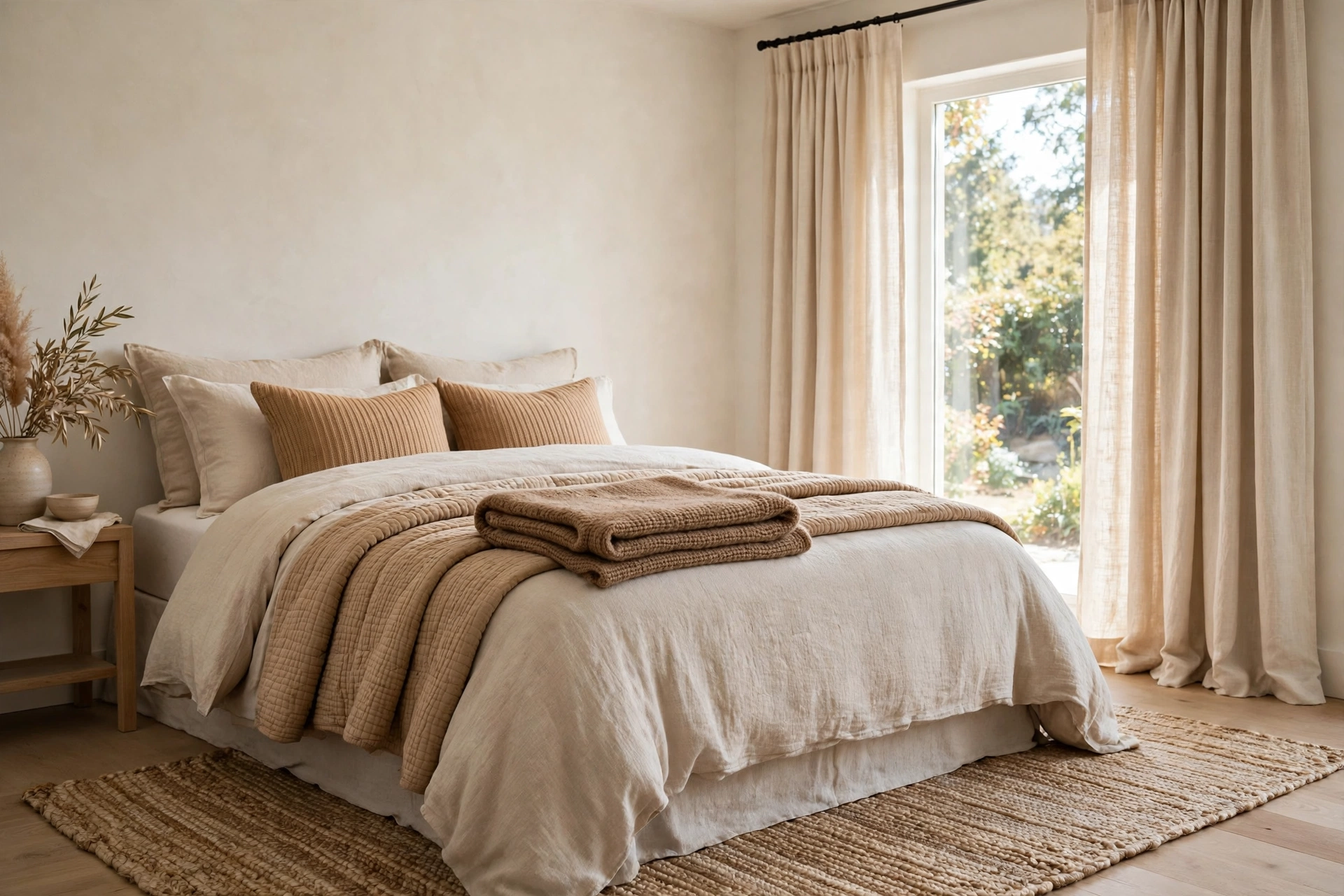
Three steps build a styled bed: a fitted sheet with a flat sheet, a duvet folded back toward the foot, and a quilt or throw laid across the bottom third. Pillow counts follow a fixed formula for a queen bed: two sleeping pillows, two shams, and one lumbar pillow at 14 x 36 inches. Five pillows total dress the bed without a nightly unloading routine. Texture does the visual work inside those layers. Linen, washed cotton, wool, velvet, and cotton percale give five distinct textures, and a bed that mixes three of the five reads layered instead of flat. Tonal shades keep the mix calm. Oatmeal, cream, and warm gray sit in one family, and that family survives trend cycles better than a printed matching set does.
Curtain and Rug Measurements
Curtain rods mount 4 to 6 inches above the window frame and extend 8 to 12 inches past each side of the glass. Panels need twice the window width for fullness, and panels cut at one times the width don’t fill the wall even in expensive fabric. True blackout panels block 85 to 100 percent of incoming light, a figure printed on better packaging and absent from most product pages. Rug sizing follows the bed, not the room. An 8×10 foot rug sits under the bottom two-thirds of a queen bed and extends 18 to 24 inches on each side, while a king bed needs a 9×12 foot rug for the same border. Pile height decides door clearance. Low pile under 0.5 inch lets doors swing free and vacuums clean in half the passes, and shoppers who measure pile before ordering buy bedroom decor once instead of twice.
Lighting Accents: Lamps, Sconces, and Warm Bulbs
Three light sources give a bedroom its evening depth: an ambient ceiling light, bedside lamps or sconces for reading, and one low accent light for the corners.
Bulb Temperature and Brightness
Bulb boxes print color temperature in Kelvin, and 2700K marks the warm white that suits bedrooms. Light Emitting Diode (LED) bulbs at 2700K cost near $10 for a two-pack at most hardware stores. Anything at 3000K and above drifts toward office light. Brightness has a target too. Bedrooms need roughly 10 to 20 lumens per square foot, so a 12 x 14 foot room lands between 1,680 and 3,360 lumens spread across all sources. Temperature affects sleep timing as well. Evening exposure to bright, cool light delays melatonin release, and warm dim light in the last hour before bed avoids that delay.
Plug-In Sconces and Dimmer Options
Hardwired sconces need an electrician, and plug-in sconces need only a drill or adhesive cord cover. Renters mount plug-in sconces beside the bed and free the whole nightstand surface in the process. Cord covers painted to match the wall hide the drop from fixture to outlet. Dimmers finish the setup for very little money. A smart bulb or an inline cord dimmer runs $10 to $15, and dropping one lamp to 20 percent brightness an hour before bed changes the room more than a new lamp at full power does. Plug-in sconces deliver the largest bedroom decor change per dollar in a rental, at roughly $35 to $60 per pair.
Nightstand and Dresser Styling Rules
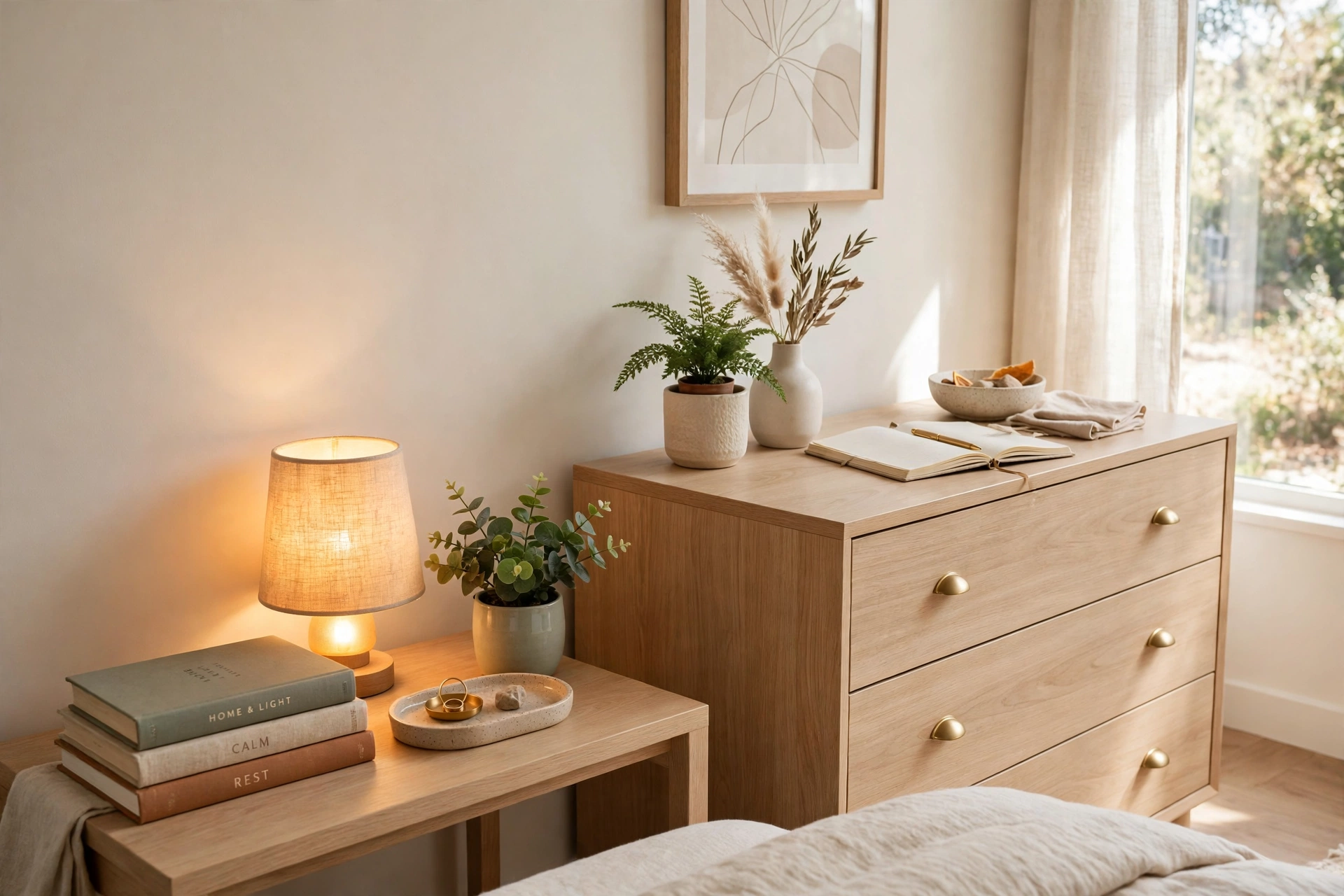
A styled nightstand holds exactly three items: a lamp, a tray or small dish, and one book or plant.
The Three Item Rule on Nightstands
The order runs lamp first, tray second, and book third. That order puts the tallest item at the back and the smallest item at the front. A tray corrals the small loose objects, such as lip balm, a watch, and reading glasses, into one footprint. Loose objects spread across a nightstand read as clutter even at low counts. Mismatched nightstands still pair well under one condition: their heights land within 2 inches of each other. One wood nightstand beside a small round table reads collected rather than accidental, provided the lamp shades sit at the same height on both sides.
Dresser Tops, Trays, and One Living Thing
Dresser tops fail by accumulation, not by choice of objects. A 12 inch tray groups bottles and daily items into a single zone, and the rest of the surface stays clear for folding and sorting. Height variation keeps the styled zone interesting. One tall item, such as a 10 inch vase, one medium item, and one low stack of two books form a stable triangle. Greenery finishes the surface. A snake plant or a pothos tolerates low light and needs water every two to three weeks, and one plant per surface is the working limit for bedrooms under 150 square feet.
Bedroom Decor Budgets at Four Price Points
A decor-only budget splits across four tiers, from $150 for bulbs, shams, and curtains to $1,500 for textiles, a rug, art, and statement lighting, with textiles taking the largest share at every tier.
Every tier below buys bedroom decor only, with no furniture and no paint in the figures. Textiles take the largest share because bedding and curtains cover the most visible area per dollar. Art spending rises last, since art size rules don’t change with the budget and only materials do.
| Tier | Total budget | What the money buys |
|---|---|---|
| Starter | $150 | 2700K bulbs throughout, two pillow shams, one throw blanket, ready-made curtain panels |
| Refresh | $400 | Starter items plus a full bedding set, blackout curtains, one table lamp pair, one framed print at 40 inches wide |
| Full layer | $800 | Refresh items plus an 8×10 foot rug, plug-in sconces, a second art piece or mirror, plants and trays |
| Premium | $1,500 | Full layer items plus a 9×12 foot rug, linen bedding, original or large-format art, a statement ceiling fixture |
Spending order inside a tier matters as much as the tier itself. Bedding comes first, curtains second, lighting third, and art last. A $400 budget spent in that order finishes a room, while the same $400 spent on art first leaves the bed, the largest surface in the room, untouched.
Common Bedroom Decor Mistakes
Five mistakes account for most unfinished looking bedrooms: a single overhead light, frame-height curtains, an undersized rug, matching furniture sets, and crowded surfaces.
One overhead light flattens every texture the room owns, and two $30 lamps fix that flatness in ten minutes. Curtains hung at the frame cut visual height, and raising the rod 4 to 6 inches restores that height without new panels. Undersized rugs shrink the bed zone. Painter’s tape settles the question before purchase: tape the outline of an 8×10 foot rug on the floor and live with the outline for two days. Matching sets date a room faster than wear does. A nightstand that differs from the dresser reads as a choice, and identical suites read as a showroom floor sample.
Frequently Asked Questions
How much should I spend on bedroom decor?
A $400 budget covers the visible layer for most bedrooms: bedding, blackout curtains, warm bulbs, and one large print. Budgets under $150 still fix lighting and pillow shams, the two changes guests notice first.
Can renters hang wall decor without drilling?
Yes. Large adhesive strip pairs rated at 8 to 16 pounds hold most framed prints, and plug-in sconces mount with clips or a single small screw. Leaning mirrors near 60 inches tall need no hardware at all.
What size rug goes under a queen bed?
An 8×10 foot rug fits a queen bed, placed under the bottom two-thirds of the frame. The rug extends 18 to 24 inches on each side, giving bare feet a soft landing zone every morning.
How many throw pillows belong on a bed?
Five pillows dress a queen bed: two sleeping pillows, two shams, and one lumbar pillow. Counts above seven turn bed making into a chore, and most extra pillows end up stored on the floor overnight.
What bulb temperature suits a bedroom?
2700K warm white suits bedrooms, printed on the bulb box as a color temperature in Kelvin. Temperatures at 3000K and higher read as office light and work against the calm a bedroom needs at night.
How high should curtains hang in a bedroom?
Mount the rod 4 to 6 inches above the window frame, closer to the ceiling in rooms under 8 feet tall. Panels then fall to the floor and the window reads taller than its true measurement.
Which decor piece should I buy first?
Buy bedding first, since the bed covers the largest visible area in the room. A duvet cover and two shams change the first impression from the doorway more than any single wall piece at the same price.
Conclusion
Rules settle bedroom decor faster than browsing does. Art width, hanging height, rug borders, bulb temperature, and surface counts all carry numbers, and numbers end guesswork at the store. Budgets then sort themselves, because a tier means little without an order of purchase inside it. Start with the bed, raise the curtains, warm the bulbs, and clear the nightstand down to three items. A queen bedroom takes an 8×10 foot rug, a 40 inch wide piece of art above the bed, and three light sources.